Posted by: Alan Wilensky | Oct 9, 2008 12:06:14 PMI wholeheartedly agree with this proposal! Take the funny money out of the system with a snap and let's keep going on with our real business. Not possible? Well, everything is possible.
Declare all CDS instruments void and non-negotiable. The Fed and SEC can do this with a little know financial administrative called, "Tough Titty."
The Tough Titty invocation was jsut recently used to spew out the 700 (nee 880) billion dollar bailout, where the Treasury and Fed basically said, "Tough Titty", to the taxpayers.
So, for the CDS unwind, I advocate that the Tough Titty rule be invoked.
Thursday, October 09, 2008
Outlaw CDSs. Now!
From The Big Picture blog comments section:
CDS Systemic Risk
CDS Systemic risk: a primer about chain settlement risk.
An easy explanation of some theoretical problems with CDSs (and I am not sure this is the real and biggest problem with CDSs). But when you have CDS coverage of USD 60 trillion floating around, this also might be a real practical problem all too soon.
An easy explanation of some theoretical problems with CDSs (and I am not sure this is the real and biggest problem with CDSs). But when you have CDS coverage of USD 60 trillion floating around, this also might be a real practical problem all too soon.
A grossly simplified example will explain it. Party A wishes to place a bet on Frannie default risk by purchasing CDS protection on Frannie. Party A buys protection from B. B is now exposed to the risk of a Frannie default and decides to hedge this risk by buying Frannie CDS protection from party C. C holds the position with net exposure for awhile, gets nervous and then offsets by purchasing protection from Party D, who then offsets the exposure with Party E.
For the sake of simplicity we will assume the default event of Frannie requires $10m in cash or securities to be delivered within 5 business days of the acknowledged default event. Now all of the parties involved have done their risk assessments of their downstream counterparty using various estimates of the counterparties credit quality and liquidity. They have each come to the conclusion, that their next counterparty has a .001% chance of failure at any point in time. They could thus assess the counterparty risk exposure in crude nominal terms as being $10mx 0.01% = $1,000. This feels safe.
Looking individually each party assumes they have $1,000 in risk. In reality A faces $4,000 in probable risk. The chain is only as strong as it weakest link. The end settlement party A has $4,000 exposure (1-(1-.0001)^4)*$1,000. Party B has a $3,000 exposure etc. The longer the chain the greater the systemic risk for the initiator and the potential for a failure to deliver on time etc.
Wednesday, October 08, 2008
Sad Guys On Trading Floors
C'mon guys, it's just money...
Sad Guys On Trading Floors
Someone made a blog of this. Lot's of interesting face expressions.
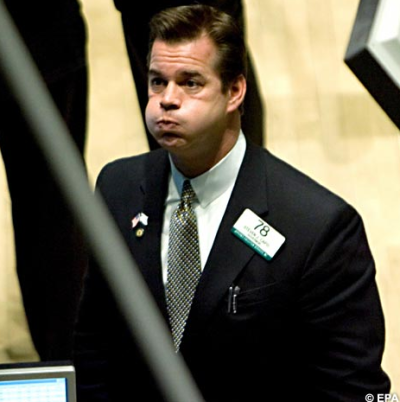
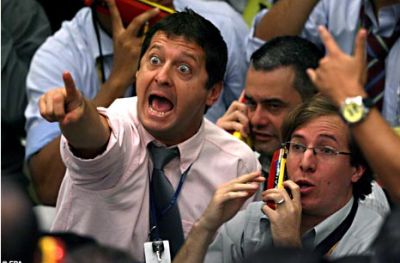
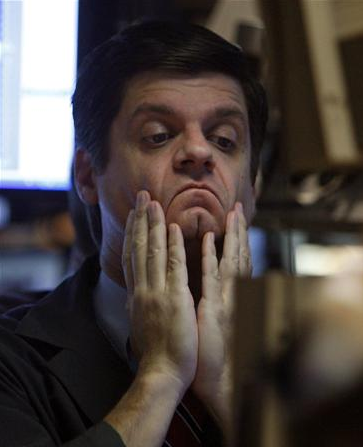
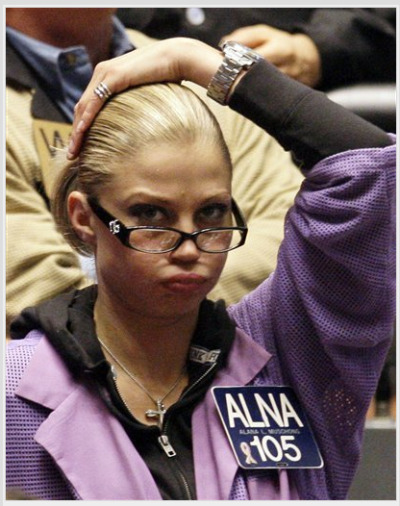
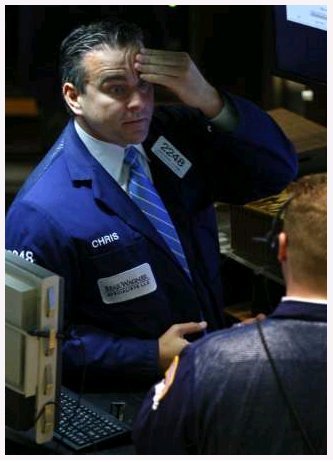
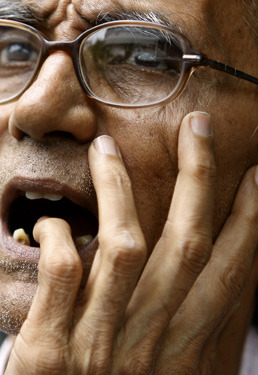
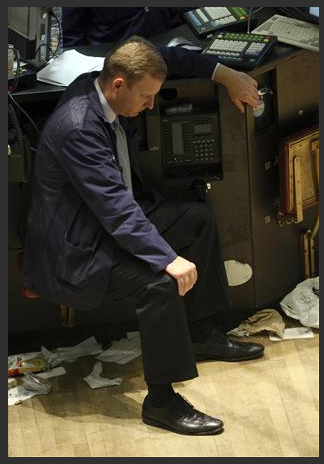
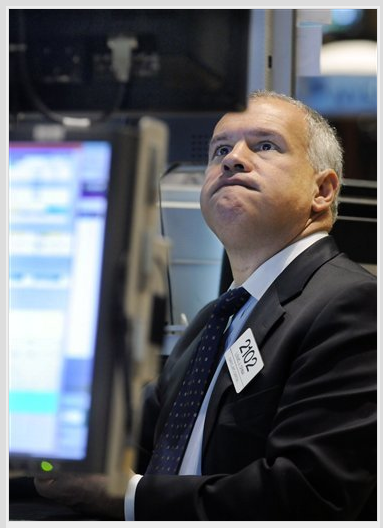
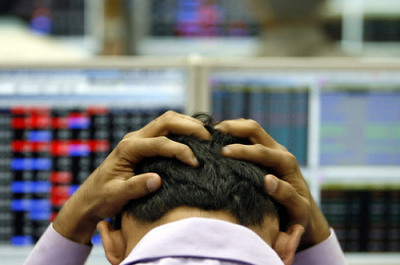
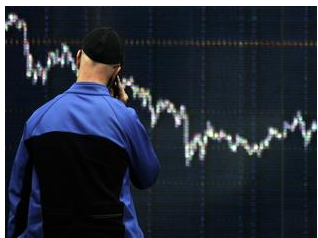
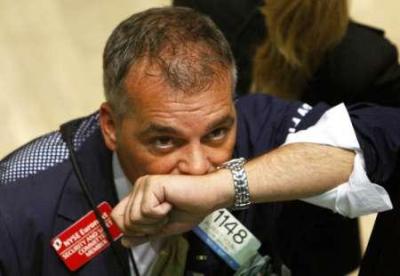
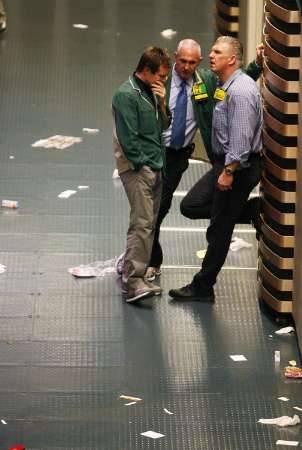
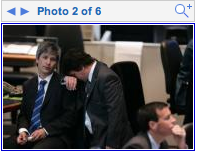
Via The Big Picture.
Sad Guys On Trading Floors
Someone made a blog of this. Lot's of interesting face expressions.
Via The Big Picture.
Thursday, October 02, 2008
Wednesday, October 01, 2008
Fear Index
MarketPsych Fear Index
The MarketPsych Fear Index shows a 10-day exponential moving average of the percentage of "Fear" words in the U.S. financial news displayed over a candlestick chart of the Nasdaq 100 (QQQQ).
...
The relative percentage of Fear-related words is on the left y-axis, and the QQQQ value is on the right y-axis. ... We have proprietary technology that detects the predictive values of different types of financial language and concepts, and which underlies our asset management.
Tuesday, September 23, 2008
Casino Suisse
An article with Credit Suisse clients complaining in the comments section about their worthless capital protection products issued by Lehman Brothers, but actively sold from Credit Suisse, got me boiling as well.
Of course these clients were naive and not informed. But what for do you need a client adviser, if you have to read the small print yourself and if you have to be well versed with the financial markets yourself!!! Do I need to study medicine in order to go to a doctor?! And many of these products are very complicated, complex, and setup to be confusing. In fact to understand them very well, not a master in finance might be in place but some mathematical background instead (just a hint, these people call themselves Quants and they study this stuff not because it helps directly to make money yourself but because it helps to get high paying jobs - well, at least so far).
Credit Suisse claims to have weathered the storm fairly well, in addition they hire away people from UBS as if they had a growing business and even look to pick up some leftover of Lehman Brothers (like the cheap backoffice operation in India) or some other easy bait that will come along.
But just like the rest of the bunch, they don't understand how lightning fast they throw away the most precious thing any bank can possibly have, that (little rest of) trust they might still have with the people (and I am not talking of UBS here, that gambled the existance of the world's biggest wealth manager with sums no client or investor would have thought possible).
If they think the purpose of a bank is to be greedy, they will learn better the hard way. The whole concept that "the purpose of a company is to make profits" alone is simply bullshit. The purpose of a bank is that people can store their money somewhere safely. The profits then are a necessary side effect. Otherwise, just hand over the money and then?!
The big scam becomes obvious.
What made Swiss banking stand out, was the absolute trust you could put in your banker. He would travel everywhere to hand you some cash (of course, only if you played in the right league). Even the big scandals with the Jewish accounts, you can also see in the light that, even after almost 100 years, the accounts and their money were still there!!! Think that about any other countries bank accounts! My bet is in other places they would get treated more like hotmail accounts, after not too much time without any "user" activity, zip zilch ninada (thanks Bill for this point).

(In Gold We Trust - Swiss Philosophy)
Sorry, but this product is sold out...
Of course these clients were naive and not informed. But what for do you need a client adviser, if you have to read the small print yourself and if you have to be well versed with the financial markets yourself!!! Do I need to study medicine in order to go to a doctor?! And many of these products are very complicated, complex, and setup to be confusing. In fact to understand them very well, not a master in finance might be in place but some mathematical background instead (just a hint, these people call themselves Quants and they study this stuff not because it helps directly to make money yourself but because it helps to get high paying jobs - well, at least so far).
Credit Suisse claims to have weathered the storm fairly well, in addition they hire away people from UBS as if they had a growing business and even look to pick up some leftover of Lehman Brothers (like the cheap backoffice operation in India) or some other easy bait that will come along.
But just like the rest of the bunch, they don't understand how lightning fast they throw away the most precious thing any bank can possibly have, that (little rest of) trust they might still have with the people (and I am not talking of UBS here, that gambled the existance of the world's biggest wealth manager with sums no client or investor would have thought possible).
If they think the purpose of a bank is to be greedy, they will learn better the hard way. The whole concept that "the purpose of a company is to make profits" alone is simply bullshit. The purpose of a bank is that people can store their money somewhere safely. The profits then are a necessary side effect. Otherwise, just hand over the money and then?!
The big scam becomes obvious.
What made Swiss banking stand out, was the absolute trust you could put in your banker. He would travel everywhere to hand you some cash (of course, only if you played in the right league). Even the big scandals with the Jewish accounts, you can also see in the light that, even after almost 100 years, the accounts and their money were still there!!! Think that about any other countries bank accounts! My bet is in other places they would get treated more like hotmail accounts, after not too much time without any "user" activity, zip zilch ninada (thanks Bill for this point).
(In Gold We Trust - Swiss Philosophy)
Sorry, but this product is sold out...
Monday, September 15, 2008
Credit Default Swaps
Why are credit default swaps potentially (well, we will soon find out their real life impact) so devastating and pose a huge risk to the financial system?
Here I will think not about the actual amounts floating around the world. They are mind bogling, incomprehensible.
And they do not appear in the balance sheets directly, except as fair value, which might be close to zero at the moment, as long as all goes well (well, now that we have the first real casualty, we will soon learn a bit more). Instead I want to think why CDSs are inherently dangerous, just as a mind experiment.
It is not only, that they allow to distribute the risk to other parties who might have much less knowledge about the risk of depth. It is that CDSs can magnify the impact of a credit default.
Credit default swaps insure bonds. BTW, a bond is nothing else than a loan.
Let's see how the world is different if a CDS gets utilised or not.
Let's say company A issues a bond B. Party C buys some of the bond B.
Company A -> issues -> Bond B
Party C -> buys Bond B
If party C changes its mind about the quality of the bond B or the company C, and thinks there might be an increased chance that company A will default on the bond B, what can it do?
A world without CDSs:
Party C -> sells bond B -> to party D.
Maybe with a loss, if the market also thinks the same. But that is not important at this point, because company A has not defaulted on the bond B at this time, and no one knows the true probability of this event yet.
A world with CDSs:
Now company C can also buy a credit default swap.
Party C -> buys from party D -> a credit default swap E.
Now party C has to pay regular interest to party D. In exchange party D holds the risk if company A defaults on bond B.
Now party D holds the risk of bond B. Just as in the first case, when party C sold the bond B to party D.
So far all is nice and beautiful.
But, what, if party D buys the bond B, there is no other party being able to buy the same bond. Only if party D wants to sell it as well. Party C can only sell the bond once!
With CDSs, now party C could kind of sell it twice, three times, as many times as it could effort to pay the interest payments. In fact, many different parties where able to kind of "sell" the bond B many times over to many different parties (all in the form of "buying" a CDS).
Party C -> buys from Party D -> credit default swap E
Party C -> buys from Party F -> credit default swap G
Party C -> buys from Party H -> credit default swap I
Party C -> buys from Party J -> credit default swap K
Party C -> buys from Party L -> credit default swap M
Party C -> buys from Party N -> credit default swap M
etc.
All of them covering for the default of Company A on Bond B.
Now if company A really defaults on bond B, now there is not only one single party that has to pay the difference of what company C can pay back and the original value of the bond, but potentially a big number of other parties will have to do the same payments! This is pure gambling in a big scale without any grounding in any productive activity!
Now the economic impact of company A has a huge impact on many different parties, not just a one to one as with the sale of a bond.
(BTW, ironically, now Party C might actually have an incredible interest of seeing Company A to fail! They are super super short now on company A.)
Getting a loan with the promise to do something productive has the risk that this party than just goes on an extended spending fee for personal gain with the corresponding impact for its creditor.
But CDSs can magnify the impact of any loan gone sour and create a massive chain reaction of insolvencies.
What is wrong with just selling Bond B if anyone doesn't like it and in the end, well, someone will have to pay up for their mistake.
The total amount insured with CDSs goes in the trillions of USD. It seems more in value than the bonds that our outstanding.
This all reminds my of an impressive experience I had years ago in the early days of internet chatting, then the common network was called internet relay chat, short IRC.
There anyone can login, take a free pseudonym, open a chat room with a chat room name that was not yet taken, and invite other people.
The person opening the room had all the power to kick people out and ban them from the room, so they could not enter again.
He was the administrator of this room. Of course, with lot's of people hanging out in a particular room, it became a sign of prestige to hold this admin right, which BTW is transferable. So normally 80 to 100% of the people in a chat room have this admin status after a while (which was visible buy adding a "@" in front of the pseudonym name, or nick name, to be precise).
With normal chat client software, mirc the standard one, there were sophisticated macro languages and other features available. E.g. you could create a list of your friends. If a friend joined your room where you had admin rights, immediately and automatically you would give them admin rights too. And there were standard macros that would help and protect your friends. E.g. someone would kick one of your friends out of the chat room, your client would automatically kick out and ban that person out of the room as well.
Now think for a moment, what this will result in, if almost everyone in this room has admin rights?
And then... one person kicks out, for fun, only one other person?!
Of course, the person kicked out will have friends, kicking out the person who just kicked someone. Now that person has friends as well, kicking out the person helping the first person being kicked out. WHAMMMMMMMMMMMMMMBOOOM!
Almost everyone get's kicked out in a chain reaction.
That is, what you call on a chat server, a Kick Fest. A festival indeed.
It is fun the first two time. Then it get's old real fast!
An example of a negative feedback loop, that happens if all do the same, fully automated, without thinking, and than one person lights a match.
Selling a CDS without having the money to be good for is like selling a naked call when you have neither the underlying stock nor money to cover it. It is not that it makes our system more stable, it makes it much more prone to a huge shake out. IMHO:).
And like a Kick Fest, it might be a good show to tell your grand children about, but it might just as quickly get pretty old restoring your "normal" life once your bank account and job has just evaporated, because a few trillion of funny/fiat money have just vanished in a man made financial mini black hole.
Here I will think not about the actual amounts floating around the world. They are mind bogling, incomprehensible.
And they do not appear in the balance sheets directly, except as fair value, which might be close to zero at the moment, as long as all goes well (well, now that we have the first real casualty, we will soon learn a bit more). Instead I want to think why CDSs are inherently dangerous, just as a mind experiment.
It is not only, that they allow to distribute the risk to other parties who might have much less knowledge about the risk of depth. It is that CDSs can magnify the impact of a credit default.
Credit default swaps insure bonds. BTW, a bond is nothing else than a loan.
Let's see how the world is different if a CDS gets utilised or not.
Let's say company A issues a bond B. Party C buys some of the bond B.
Company A -> issues -> Bond B
Party C -> buys Bond B
If party C changes its mind about the quality of the bond B or the company C, and thinks there might be an increased chance that company A will default on the bond B, what can it do?
A world without CDSs:
Party C -> sells bond B -> to party D.
Maybe with a loss, if the market also thinks the same. But that is not important at this point, because company A has not defaulted on the bond B at this time, and no one knows the true probability of this event yet.
A world with CDSs:
Now company C can also buy a credit default swap.
Party C -> buys from party D -> a credit default swap E.
Now party C has to pay regular interest to party D. In exchange party D holds the risk if company A defaults on bond B.
Now party D holds the risk of bond B. Just as in the first case, when party C sold the bond B to party D.
So far all is nice and beautiful.
But, what, if party D buys the bond B, there is no other party being able to buy the same bond. Only if party D wants to sell it as well. Party C can only sell the bond once!
With CDSs, now party C could kind of sell it twice, three times, as many times as it could effort to pay the interest payments. In fact, many different parties where able to kind of "sell" the bond B many times over to many different parties (all in the form of "buying" a CDS).
Party C -> buys from Party D -> credit default swap E
Party C -> buys from Party F -> credit default swap G
Party C -> buys from Party H -> credit default swap I
Party C -> buys from Party J -> credit default swap K
Party C -> buys from Party L -> credit default swap M
Party C -> buys from Party N -> credit default swap M
etc.
All of them covering for the default of Company A on Bond B.
Now if company A really defaults on bond B, now there is not only one single party that has to pay the difference of what company C can pay back and the original value of the bond, but potentially a big number of other parties will have to do the same payments! This is pure gambling in a big scale without any grounding in any productive activity!
Now the economic impact of company A has a huge impact on many different parties, not just a one to one as with the sale of a bond.
(BTW, ironically, now Party C might actually have an incredible interest of seeing Company A to fail! They are super super short now on company A.)
Getting a loan with the promise to do something productive has the risk that this party than just goes on an extended spending fee for personal gain with the corresponding impact for its creditor.
But CDSs can magnify the impact of any loan gone sour and create a massive chain reaction of insolvencies.
What is wrong with just selling Bond B if anyone doesn't like it and in the end, well, someone will have to pay up for their mistake.
The total amount insured with CDSs goes in the trillions of USD. It seems more in value than the bonds that our outstanding.
This all reminds my of an impressive experience I had years ago in the early days of internet chatting, then the common network was called internet relay chat, short IRC.
There anyone can login, take a free pseudonym, open a chat room with a chat room name that was not yet taken, and invite other people.
The person opening the room had all the power to kick people out and ban them from the room, so they could not enter again.
He was the administrator of this room. Of course, with lot's of people hanging out in a particular room, it became a sign of prestige to hold this admin right, which BTW is transferable. So normally 80 to 100% of the people in a chat room have this admin status after a while (which was visible buy adding a "@" in front of the pseudonym name, or nick name, to be precise).
With normal chat client software, mirc the standard one, there were sophisticated macro languages and other features available. E.g. you could create a list of your friends. If a friend joined your room where you had admin rights, immediately and automatically you would give them admin rights too. And there were standard macros that would help and protect your friends. E.g. someone would kick one of your friends out of the chat room, your client would automatically kick out and ban that person out of the room as well.
Now think for a moment, what this will result in, if almost everyone in this room has admin rights?
And then... one person kicks out, for fun, only one other person?!
Of course, the person kicked out will have friends, kicking out the person who just kicked someone. Now that person has friends as well, kicking out the person helping the first person being kicked out. WHAMMMMMMMMMMMMMMBOOOM!
Almost everyone get's kicked out in a chain reaction.
That is, what you call on a chat server, a Kick Fest. A festival indeed.
It is fun the first two time. Then it get's old real fast!
An example of a negative feedback loop, that happens if all do the same, fully automated, without thinking, and than one person lights a match.
Selling a CDS without having the money to be good for is like selling a naked call when you have neither the underlying stock nor money to cover it. It is not that it makes our system more stable, it makes it much more prone to a huge shake out. IMHO:).
And like a Kick Fest, it might be a good show to tell your grand children about, but it might just as quickly get pretty old restoring your "normal" life once your bank account and job has just evaporated, because a few trillion of funny/fiat money have just vanished in a man made financial mini black hole.
Saturday, September 06, 2008
Gigantic Bank Run?
A comment from the comments page at The Big Picture post regarding the Funny and Freaky bailout:
Here Comes the Half Trillion Dollar Fannie/Freddie Bailout!
Here Comes the Half Trillion Dollar Fannie/Freddie Bailout!
Cold Facts re US Banks & FDIC
A. There is roughly $6.84 Trillion in bank deposits. $2.60 Trillion of that is uninsured. There is only $53 billion in FDIC insurance to cover $6.84 Trillion in bank deposits. Indymac will eat up roughly $8 billion of that.
B. Of the $6.84 Trillion in bank deposits, the total cash on hand at banks is a mere $273.7 Billion. Where is the rest of the loot? The answer is in off balance sheet SIVs, imploding commercial real estate deals, Alt-A liar loans, Fannie Mae and Freddie Mac bonds, toggle bonds where debt is amazingly paid back with more debt, and all sorts of other silly (and arguably fraudulent) financial wizardry schemes that have bank and brokerage firms leveraged at 30-1 or more. Those loans cannot be paid back.
Now this GSEs bailout?! Printing the American pesos is the last desperate measure. Next - CRISIS OF CONFIDENCE
Posted by: Sunny 129 | Sep 6, 2008 11:55:47 AM
Monday, September 01, 2008
How To Steal A Company (In Russia)
... and if that doesn't work, manufacture a USD 230 million tax refund. RUSSIAN ROULETTE
Via Trader Daily.
Via Trader Daily.
Sunday, August 31, 2008
Market Bottoms
A very common sense article about what differenciates market bottoms from market tops:
The Aleph Blog: The Fundamentals of Market Bottoms
The Aleph Blog: The Fundamentals of Market Bottoms
The Investor Base Becomes Fundamentally-DrivenVia The Big Picture.
1) Now, by fundamentally-driven, I don’t mean that you are just going to read lots of articles telling how cheap certain companies are. There will be a lot of articles telling you to stay away from all stocks because of the negative macroeconomic environment, and, they will be shrill.
2) Fundamental investors are quiet, and valuation-oriented. They start quietly buying shares when prices fall beneath their threshold levels, coming up to full positions at prices that they think are bargains for any environment.
3) But at the bottom, even long-term fundamental investors are questioning their sanity. Investors with short time horizons have long since left the scene, and investor with intermediate time horizons are selling. In one sense investors with short time horizons tend to predominate at tops, and investors with long time horizons dominate at bottoms.
4) The market pays a lot of attention to shorts, attributing to them powers far beyond the capital that they control.
5) Managers that ignored credit quality have gotten killed, or at least, their asset under management are much reduced.
6) At bottoms, you can take a lot of well financed companies private, and make a lot of money in the process, but no one will offer financing then. M&A volumes are small.
7) Long-term fundamental investors who have the freedom to go to cash begin deploying cash into equities, at least, those few that haven’t morphed into permabears.
8 ) Value managers tend to outperform growth managers at bottoms, though in today’s context, where financials are doing so badly, I would expect growth managers to do better than value managers.
9) On CNBC, and other media outlets, you tend to hear from the “adults” more often. By adults, I mean those who say “You should have seen this coming. Our nation has been irresponsible, yada, yada, yada.” When you get used to seeing the faces of David Tice and James Grant, we are likely near a bottom. The “chrome dome count” shows more older investors on the tube is another sign of a bottom.
10) Defined benefit plans are net buyers of stock, as they rebalance to their target weights for equities.
11) Value investors find no lack of promising ideas, only a lack of capital.
12) Well-capitalized investors that rarely borrow, do so to take advantage of bargains. They also buy sectors that rarely attractive to them, but figure that if they buy and hold for ten years, they will end up with something better.
13) Neophyte investors leave the game, alleging the the stock market is rigged, and put their money in something that they understand that is presently hot — e.g. money market funds, collectibles, gold, real estate — they chase the next trend in search of easy money.
14) Short interest reaches high levels; interest in hedged strategies reaches manic levels.
...
No Bottom Yet
There are some reasons for optimism in the present environment. Shorts are feared. Value investors are seeing more and more ideas that are intriguing. Credit-sensitive names have been hurt. The yield curve has a positive slope. Short interest is pretty high. But a bottom is not with us yet, for the following reasons:
* Implied volatility is low.
* Corporate defaults are not at crisis levels yet.
* Housing prices still have further to fall.
* Bear markets have duration, and this one has been pretty short so far.
* Leverage hasn’t decreased much. In particular, the investment banks need to de-lever, including the synthetic leverage in their swap books.
* The Fed is not adding liquidity to the system.
* I don’t sense true panic among investors yet. Not enough neophytes have left the game.
Not all of the indicators that I put forth have to appear for there to be a market bottom. A preponderance of them appearing would make me consider the possibility, and that is not the case now.
Some of my indicators are vague and require subjective judgment. But they’re better than nothing, and kept me in the game in 2001-2002. I hope that I — and you — can achieve the same with them as we near the next bottom.
Friday, August 08, 2008
Risk Manager
Very good article how a risk manager sees the current debacle:
The Economist: Confessions of a risk manager
An insider explains why it is so hard to stop traders behaving recklessly
The Economist: Confessions of a risk manager
An insider explains why it is so hard to stop traders behaving recklessly
But we did not believe that prices on AAA assets could fall by more than about 1% in price. A 20% drop on assets with virtually no default risk seemed inconceivable—though this did eventually occur.
...
The focus of our risk management was on the loan portfolio and classic market risk. Loans were illiquid and accounted for on an accrual basis in the “banking book” rather than on a mark-to-market basis in the “trading book”. Rigorous credit analysis to ensure minimum loan-loss provisions was important. Loan risks and classic market risks were generally well understood and regularly reviewed.
...
The gap in our risk management only opened up gradually over the years with the growth of traded credit products such as CDO tranches and other asset-backed securities. These sat uncomfortably between market and credit risk. The market-risk department never really took ownership of them, believing them to be primarily credit-risk instruments, and the credit-risk department thought of them as market risk as they sat in the trading book.
The explosive growth and profitability of the structured-credit market made this an ever greater problem. Our risk-management response was half-hearted.
...
Gradually the structures became more complicated. Since they were held in the trading book, many avoided the rigorous credit process applied to the banking-book assets which might have identified some of the weaknesses.
...
Collective common sense suffered as a result. Often in meetings, our gut reactions as risk managers were negative. But it was difficult to come up with hard-and-fast arguments for why you should decline a transaction, especially when you were sitting opposite a team that had worked for weeks on a proposal, which you had received an hour before the meeting started. In the end, with pressure for earnings and a calm market environment, we reluctantly agreed to marginal transactions.
Over time we accumulated a balance-sheet of traded assets which allowed for very little margin of error. We owned a large portfolio of “very low-risk” assets which turned out to be high-risk. A small price movement on billions of dollars’ worth of securities would translate into large mark-to-market losses.
...
We had not fully appreciated that 20% of a very large number can inflict far greater losses than 80% of a small number.
Tuesday, August 05, 2008
John Paulson
Wow, this is ironic.
Die Zeit: Die Global Zocker
Just funny that he kept it at Bear Stearns. Imagine it would have all vanished again in a Bear Stearns meltdown, haha, easy come, easy go. But apparently Greenspan not only helped him to make the money... I wonder how much help Phil Gramm is for UBS today?!
Via WEISSGARNIX.
Die Zeit: Die Global Zocker
Hinter ihm liegt ein langes Wochenende – eines, an dem das amerikanische Finanzsystem bedrohlich wackelte, weil die Investmentbank Bear Stearns Bankrott angemeldet hat. Auch Paulson hat seine Gelder dort, über Bear Stearns wickelte er die Käufe und Verkäufe für seinen Fonds ab. Das ganze Wochenende hat er in Meetings verbracht, Besprechungen am Telefon geführt. Bis klar war, sein Geld ist sicher: JP Morgan übernimmt Bear Stearns, und die amerikanische Notenbank hilft beim Kauf.As you may recall, John Paulson made USD 15 billion in 2007 betting on a melting sub prime market. So if you ask, where did the money go that UBS etc. lost, well, he has a chunk of it now. Nice play money. But maybe he has a better idea what to do with it, so I thought.
Dass Paulson den ehemaligen amerikanischen Notenbankchef Alan Greenspan vor Kurzem als Berater eingestellt hat, hat an jenem Wochenende wahrscheinlich nicht geschadet.
Just funny that he kept it at Bear Stearns. Imagine it would have all vanished again in a Bear Stearns meltdown, haha, easy come, easy go. But apparently Greenspan not only helped him to make the money... I wonder how much help Phil Gramm is for UBS today?!
Via WEISSGARNIX.
Saturday, August 02, 2008
Fortis
Fortis bows to pressure and ousts CFO
the ambitious ABN Amro deal, which saw Fortis take over its Dutch rival’s retail banking, private banking and asset management arms for €24bn last autumn.Not long ago Fortis used to pay a dividend of EUR 1.40 per share annually. Obviously the market didn't believe this was sustainable and was right (would be a dividend yield of over 15 % otherwise).
The move, undertaken in concert with Royal Bank of Scotland and Santander of Spain, landed Fortis in a precarious position even after it undertook Europe’s second-largest rights issue ever, worth €13.4bn, to finance it.
The bank then startled investors in June when it scrapped its interim dividend and raised a further €1.5bn of equity as part of a plan to boost its capital reserves by €8.3bn in spite of assurances that no such move was necessary.
Shares in Fortis, which yesterday rose 8 cents to €9.16, are worth a third of their €29 peak before the crunch, leaving the bank with a market capitalisation worth less than what it paid to enter the ABN Amro deal.
Subscribe to:
Posts (Atom)