The Long Johns - The Last Laugh - George Parr - Subprime
Pointer from Michael Covel.
Thursday, December 06, 2007
Monday, December 03, 2007
Paul Tudor Jones
Paul Tudor Jones II interview by
Joel Ramin
January 13, 2000
Joel Ramin
January 13, 2000
I applied to Harvard Business School, got accepted and was about to go. I literally was packed up to go and then I thought, 'this is crazy', because for what I'm doing here, they're not going to teach me anything. This skill set is not something that they teach in business school. So I didn't go, I stayed, but I was really bored because there wasn't the personal interaction that was something that I craved and having colleagues and being in a clean atmosphere and that was when I started my fund. All through growing up I've been involved in team sports and fraternities and in school I was involved in a whole variety of activities all of which were team oriented and when I was on my own I was printing money every month, but I wasn't getting the psychic satisfaction from itA good summary of hiw rules can be found at Wikipedia.
...
Q: Are you more naturally bearish or bullish?
Paul Tudor Jones: Bearish, I think. I would have difficulty asking anyone to pay 10 or 20 times earnings for my earnings capability for the rest of my life. I would think you're crazy to do that even though it might be a great deal, so the concept of paying one-hundred-and-something times earnings for any company for me is just anathema. Having said that, at the end of the day, your job is to buy what goes up and to sell what goes down so really who gives a damn about PE's? If it's going up you're supposed to be long it. But there's no question that it's just easier for me to leverage with some degree of conviction the short side of some markets.
...
Q: Let's play a word association game. I'll say a word and you say whatever comes to mind.
Q: Technical analysis
Paul Tudor Jones: Made well over half the money that I've made in my lifetime.
Q: Fundamental Analysis
Paul Tudor Jones: Made the rest.
Q: Are you better at one or the other?
Paul Tudor Jones: Probably technical analysis.
Q: Market efficiency
Paul Tudor Jones: No such thing.
Q: Long Term Capital Management
Paul Tudor Jones: Icarus.
Q: Black Monday
Paul Tudor Jones: It was like watching a natural disaster from the sidelines. I was intimately involved in that day, but the macro implications of what was happening overwhelmed any personal considerations that I had.
Q: Warren Buffet
Paul Tudor Jones: His aversion to paying taxes made him a great investor.
Sunday, December 02, 2007
Jim Simons
Bloomberg: Simons at Renaissance Cracks Code, Doubling Assets (Update1)
``There are just a few individuals who have truly changed how we view the markets,'' says Theodore Aronson, principal of Aronson + Johnson + Ortiz LP, a quantitative money management firm in Philadelphia with $29.3 billion in assets. ``John Maynard Keynes is one of the few. Warren Buffett is one of the few. So is Jim Simons.''
...
With his myriad positions in different markets, Simons likens his approach to the extensive farming he once practiced in Colorado, using center pivot irrigation to grow wheat on thousands of acres.
``Every little stalk of wheat was not doing so great, but most of them were, so you're working on statistics,'' Simons says.
By contrast, he says, the traditional focused investing practiced by Warren Buffett is akin to intensive farming, in which each individual plant really counts. ``It's two completely different ends of the spectrum,'' Simons says.
...
Scientific exploration underpins all of Simons's work. ``What motivates me?'' he says. ``I'm ambitious and I like to do things well. I love to create something that really works. We have lots and lots and lots of strategies, and each new one gives me a lot of pleasure, to see something new that works.''
...
Former employees say observers may gain as much insight into Renaissance's performance by scrutinizing a more obvious factor: Simons has succeeded in building a pretty good business model. First, it's a firm run by and for scientists.
``I've always said Renaissance's secret is that it didn't hire MBAs,'' says Berlekamp, who blames the herdlike mentality among business school graduates for poor investor returns.
Programming and modeling are treated as the heart of the firm's advantage -- not an expense. ``If you needed a lot of computer power, the decision was based on whether you needed it, not the budget,'' says Peter Weinberger, former chief technology officer at Renaissance and now a software engineer at Google Inc.
Decisions are made quickly and feedback is constant. ``One of the things about Renaissance is that there's a feeling of urgency,'' says Frey, who left to teach applied mathematics and statistics at Stony Brook in 2004.
``We always believed that there was a wolf at the door, that somebody would get there before we did.''
Saturday, December 01, 2007
Joe Ackermann in Zurich
If you are located in Zurich, you might take notice of this event:
Die Bedeutung von Schwellenländern in der globalen Strategie der Deutschen Bank
2007-12-05, 18:15
Karl Schmid-Strasse 4, 8006 Zürich; KO2, Raum: F 180

Die Bedeutung von Schwellenländern in der globalen Strategie der Deutschen Bank
2007-12-05, 18:15
Karl Schmid-Strasse 4, 8006 Zürich; KO2, Raum: F 180
Thursday, November 29, 2007
Buffett and Freddie Mac
The Washington Post: Buffett Testifies That He Saw Early Signs of Freddie Mac's Woes
It would be an interesting (but maybe time consuming:) exercise to go back and read the old annual reports and see if you also detect something fishy.
It would be an interesting (but maybe time consuming:) exercise to go back and read the old annual reports and see if you also detect something fishy.
Buffett said he was troubled in part by a Freddie Mac investment that had nothing to do with its business.
"I follow the old dictum: There's never just one cockroach in the kitchen," Buffett said.
...
Buffett said he bought stock in Freddie Mac in the 1980s because "it looked ridiculously cheap." He said his company became one of Freddie Mac's largest shareholders before it began liquidating its stake in the late 1990s at an eventual profit of about $2.75 billion.
Buffett said he met with Brendsel and former Freddie Mac president David W. Glenn five or six times over the years at Brendsel's request, initially at a summer house Buffett had in Laguna Beach, Calif. Brendsel requested and followed some of his recommendations on whom Freddie Mac should appoint to its board, Buffett said.
Buffet said he became troubled when Freddie Mac made an investment unrelated to its mission. He wasn't clear on the specifics but said he "didn't think that made any sense at all" and "was concerned about what they might be doing . . . that I didn't know about."
...
Buffett said he reviewed Freddie Mac's annual reports every year he held stock in the company.
...
Buffett said he thought he expressed his concern to Brendsel in several conversations but added that he didn't keep notes or a diary and couldn't recall details.
...
Asked by the judge, William B. Moran, whether he felt his concerns were vindicated, Buffett said, "I think they were fully vindicated."
Wednesday, November 28, 2007
Research in India
The trend to outsourcing is not just in IT:
Bloomberg: JPMorgan, Deutsche Bank Keep Mum on Indian Intellectual Capital
Bloomberg: JPMorgan, Deutsche Bank Keep Mum on Indian Intellectual Capital
Tuesday, November 27, 2007
UBS in Trouble
UBS seems to be in trouble, according a Citigroup analyst:
Citi do a Whitney on UBS - “A major reversal of fortune”
Citi do a Whitney on UBS - “A major reversal of fortune”
While UBS have the second highest ABS CDO exposure, they have taken one of the lowest writedowns.After all, Citi should know, they just got an expensive equity infusion themselves.
Clearly, UBS are not marking their assets at current market prices, and are still heavily relying on marked to model prices. Consider also the fact that many of the CDOs UBS arranged and sponsored have been some of the worst hit - like the appropriately named Vertical Capital, a CDO whose AAA debt was slashed 14 notches to junk in one fell swoop.
...
The third scenario is a worst-case scenario. Under this scenario (50% writedowns on HG ABS CDOs and 100% on mezz ABS CDOs), UBS would end up with a substantial SFr22bn writedown. The group’s Tier 1 ratio would drop to 5.8% (Basel II). Even after cutting the dividend and accounting for a lower group Tier 1 ratio of 9% (Basel II), a capital shortfall of SFr 8.5bn would remain, raising the prospects of a large capital increase/rights issue.
Monday, November 26, 2007
Taking the Other Side
... of the zero sum game, see this article at Financial Times:
1000% hedge fund wins subprime bet
1000% hedge fund wins subprime bet
The decision to use derivatives to short, or bet against, low-quality US home loans taken by a select group of hedge funds last year appears to have become the most profitable single trade of all time, making well over $20bn in total so far this year. John Paulson’s New York-based Paulson & Co, the biggest of the group with $28bn under management, is said by investors to have made $12bn profit from the trade already.
...
“Our entire banking system is a complete disaster,” he wrote. “In my opinion, nearly every major bank would be insolvent if they marked their assets to market.” He also said he would be putting some of his own profits into gold and other precious metals.
Friday, November 23, 2007
David Einhorn's Remarks
Heilbrunn Center for Graham & Dodd Investing
17th Annual Graham & Dodd Breakfast
David Einhorn’s Prepared Remarks
October 19, 2007
Very good long article about the whole sub prime, credit, structured products, rating agencies, banking crisis.
17th Annual Graham & Dodd Breakfast
David Einhorn’s Prepared Remarks
October 19, 2007
Very good long article about the whole sub prime, credit, structured products, rating agencies, banking crisis.
The crisis came because there have been a lot of bad practices and a lot of bad ideas. Securitization is a mediocre idea. Re-securitization of already securitized assets into a CDO is a bad idea. Re-securitization of CDOs into CDO-squared is a really bad idea. So is funding a pool of long-term illiquid assets with very short-term funding in the so called asset backed commercial paper market. And as I will get to in a moment, it is a horrendous idea to delegate most of the responsibility for assessing credit risk to a group of credit rating agencies paid for by the issuers rather than the buyers of bonds.
...
Last Saturday’s Wall Street Journal reported that the big fear that the US Treasury Department is working to avoid is, “the danger that dozens of huge bank-affiliated funds will be forced to unload billions of dollars in mortgage-backed securities and other assets, driving down their prices in a fire sale. That could force big write-offs by banks, brokerages and hedge funds that own similar investments and would have to mark them down to the new, lower market prices.” So the fear is that the new prices are actually disclosed. This is the “don’t ask-don’t tell” method of security valuation.
In my view, the credit issues aren’t just about subprime. Subprime is what the media says. Subprime is what parts of our financial establishment say. Subprime is about them — those people and the people who made foolish loans to them. The word “Subprime” is pejorative. Subprime is not about us, for we are not subprime. How convenient to be able to pass the blame.
There has been much talk from politicians and pundits about predatory lending –that is making loans at high rates to people who couldn’t reasonably be expected to pay them back. They are right, that is a bad practice, but that is not what’s shaking the markets. At issue today is that lenders of all sorts have lent too much money and did not demand enough interest to compensate them for the risks they took. There has been a colossal undercharging for credit across the board.
...
The latest hedge fund getting bad press is Ellington management, a large participant in the mortgage business. A couple of weeks ago, it suspended redemptions from its funds because it could not determine the value of its assets. Apparently they own what I’d call 20/90 bonds. 20-bid and 90-offered. While Ellington made negative headlines for doing the right thing, acknowledging it is unfair to let people in or out in such circumstance, does anyone believe that the large mortgage players like Bear Stearns and Lehman Brothers don’t also have large portfolios of 20/90 bonds? When they reported their quarterly results, investors marveled at their risk controls. However, Lehman moved about $9 billion of mortgage securities into a special classification called Level 3 under FASB 157, which gives them more valuation discretion. Both Lehman and Bear claimed their Level 3 portfolios actually had gains in the quarter, so it looks like they put the 20/90 bonds closer to 90 or perhaps even 95. This appears to be a classic example of a hedge fund being vilified for doing the right thing, while others are cheered for doing the opposite.
...
In early September, a senior Moody’s executive confirmed this suspicion at a small private dinner sponsored by one of the brokerage firms. He said, “Moody’s would never lower the credit ratings of a financial guarantor, because that would put the guarantors out of business.”
It is plain that the States and Cities and Towns in this country are triple A credits without triple A ratings and the financial guarantee companies have triple A ratings without being triple A credits.
Thursday, November 22, 2007
UBS Insider Transactions
Have a look at this insider transactions list at the SWX Swiss Stock Exchange.
At the moment (2007-11-22) there is also a lot of selling of Lindt going on, a single but bigger sale of Roche, Swatch is on the buy list, and also someone is heavily investing into Straumann.
At the moment (2007-11-22) there is also a lot of selling of Lindt going on, a single but bigger sale of Roche, Swatch is on the buy list, and also someone is heavily investing into Straumann.
Issuer UBS AG Transaction date 20.11.2007 by a non-executive member of the board of directors Type of transaction Purchase of 20'000 securities amounting to CHF 980'000.00 (CHF 49.00 / security) Type of security Equity securities ISIN CH0024899483
Issuer UBS AG Transaction date 19.11.2007 by a non-executive member of the board of directors Type of transaction Purchase of 1 securities amounting to CHF 262'500.00 (CHF 262500.00 / security) Type of security Equity securities ISIN CH0024899483 Further transaction details Ein externes VR Mitglied hat die Wahl getroffen, als Bestandteil seiner Vergütung zusätzlich zu den fest zugeteilten Aktien den Betrag von CHF 262'500.-- in UBS Aktien zu beziehen. Die entsprechenden Aktien werden nach Festsetzung des Preises Ende Februar 2008 zugeteilt.
Issuer UBS AG Transaction date 05.11.2007 by a non-executive member of the board of directors Type of transaction Purchase of 20'000 securities amounting to CHF 1'100'000.00 (CHF 55.00 / security) Type of security Equity securities ISIN CH0024899483
Issuer UBS AG Transaction date 02.11.2007 by a non-executive member of the board of directors Type of transaction Sale of 90 securities amounting to CHF 39'753.80 (CHF 441.71 / security) Type of security Put option ISIN CH0024899483 Further transaction details Strike price CHF 54,75

Tuesday, November 20, 2007

GuruFocus
www.gurufocus.com
Where Buffett Wannabes Trade Tips
GuruFocus tracks the Stock Picks and Portfolio Holdings of Warren Buffett, George Soros and other guru investors like Ruane Cunniff, Mohnish Pabrai, Tweedy Browne, Mark Hillman.Some background story from the BusinessWeek:
Where Buffett Wannabes Trade Tips
Monday, November 19, 2007
The Complete TurtleTrader
The book is in the mail already, so I am not gonna read this article. Nevertheless author Michel Covel wrote a three page summation at the Daily Trader (free login required) about the story of his latest book:
Secrets Of The ‘Turtles’
Here is
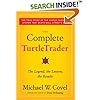 The Complete TurtleTrader at Amazon.
Other worthwhile books related to either trend trading or 'the turtles' (or Richard Dennis) are
 Trend Following, also by Michael Covel, and
 Way of the Turtle by Curtis Faith.
It you like one of those books, you might bookmark Michael Covel's blog as well.
Update: I couldn't stop me from reading the article. Here is a quote I like:
Secrets Of The ‘Turtles’
Here is
The Complete TurtleTrader at Amazon.Other worthwhile books related to either trend trading or 'the turtles' (or Richard Dennis) are
Trend Following, also by Michael Covel, andWay of the Turtle by Curtis Faith.It you like one of those books, you might bookmark Michael Covel's blog as well.
Update: I couldn't stop me from reading the article. Here is a quote I like:
“If it’s raining, all that means to me is I need an umbrella,” he once joked. “You don’t get any profit from fundamental analysis. You get profit from buying and selling. Why bother with appearances when you can go right to the reality of price?” The money, for Dennis, was simply a means of keeping score. “Trading is a little bit like hitting a ball,” he would say. “If you’re thinking what your batting average should be, you’re not concentrating on the right thing when you hit the ball. Dollars are the batting average of the trader.”
Subscribe to:
Posts (Atom)