In English: Penny Pincher
In German: Pfennigfuchser
In Swiss-German: Rappenspalter
Thursday, April 15, 2010
Sunday, April 04, 2010
Money, Money, Money
ABBA - Money Money Money (Abba-dabba-doo)
I work all night, I work all day, to pay the bills I have to pay
Ain't it sad
And still there never seems to be a single penny left for me
That's too bad
In my dreams I have a plan
If I got me a wealthy man
I wouldn't have to work at all, I'd fool around and have a ball
Money, money, money
Must be funny
In the rich man's world
Money, money, money
Always sunny
In the rich man's world
Aha-ahaaa
All the things I could do
If I had a little money
It's a rich man's world
A man like that is hard to find but I can't get him off my mind
Ain't it sad
And if he happens to be free I bet he wouldn't fancy me
That's too bad
So I must leave, I'll have to go
To Las Vegas or Monaco
And win a fortune in a game, my life will never be the same
Money, money, money
Must be funny
In the rich man's world
Money, money, money
Always sunny
In the rich man's world
Aha-ahaaa
All the things I could do
If I had a little money
It's a rich man's world
Money, money, money
Must be funny
In the rich man's world
Money, money, money
Always sunny
In the rich man's world
Aha-ahaaa
All the things I could do
If I had a little money
It's a rich man's world
It's a rich man's world
Thursday, March 18, 2010
giacobbo/müller
In Swiss German, but it is soo funny (if you happen(ed) to live (and work) around here):
UBS Mitarbeiter 2008
And, still relevant...
Giacobbo Müller - Die Achse Kosovo-Lichtenstein
UBS Mitarbeiter 2008
And, still relevant...
Giacobbo Müller - Die Achse Kosovo-Lichtenstein
Wednesday, March 17, 2010
Thursday, February 25, 2010
Euro STOXX 50 in Gold OZ
With talk recently about Gold being on an all time high denominated in Euro, let's have a look at the most important European index, the Euro STOXX 50: in Gold troy ounces!
(click on image for a bigger version)
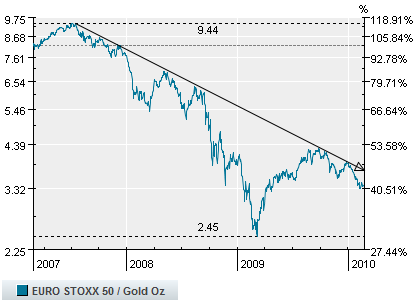
What a wonderful downward trend for the Euro STOXX 50 in Gold. Or could we call it deflation?! And maybe it's inflation for Gold in terms of Euro!? Inflation - Deflation: is it just a matter of perspective?
Source Telekurs iD.
(click on image for a bigger version)
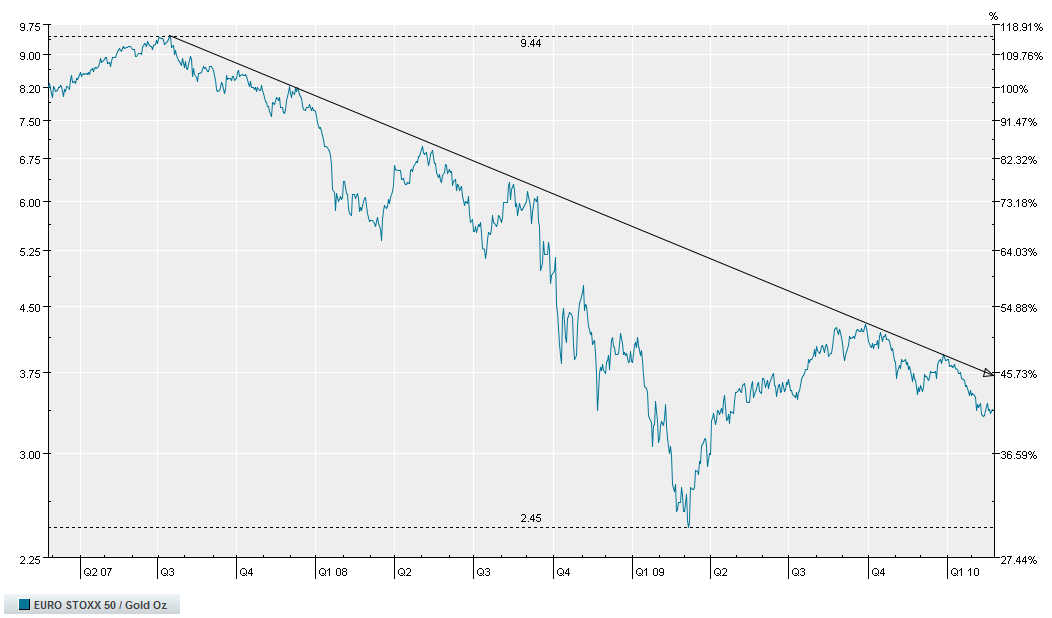
What a wonderful downward trend for the Euro STOXX 50 in Gold. Or could we call it deflation?! And maybe it's inflation for Gold in terms of Euro!? Inflation - Deflation: is it just a matter of perspective?
Source Telekurs iD.
Saturday, February 20, 2010
Swiss Statistic
This attention-grabbing article (Unterhalt des SBB-Schienennetzes massiv teurer - OMG: CHF 850 mio!) about the cost of the Swiss railway tracks in the Swiss "Tagi" calls for looking up of the latest Swiss population statistic:
Bundesamt für Statistik: Bevölkerung - Die wichtigsten Zahlen
P.S. according to the BAV, the CHF 850 mio are additional costs! If the Tagi is right and this is 60% of the initially planned cost, that amounts to maintenance cost of CHF 2.3 bia for the track system. This comes down to a total annual amount of CHF 294 per Swiss resident.
Bundesamt für Statistik: Bevölkerung - Die wichtigsten Zahlen
Turns out CHF 110 for each Swissi (per year)! Seems to be a good deal and cheap for top notch infrastructure.Wichtigste Kennzahlen
2008 Ständige Wohnbevölkerung am Jahresende (in 1000) 7701.9 65 Jahre und älter 16.6 Ausländische Staatsangehörige (in %) 21.7 Bevölkerungswachstum (in %) 1.4 Anzahl Kinder je Frau 1.48 Lebenserwartung bei der Geburt (Jahre) Männer 79.7 Frauen 84.4 Scheidungen je 100 Heiraten 47 Haushalte Einpersonenhaushalte (in 1000) 1246.7 Familienhaushalte mit Kindern (in 1000) 1086.3 Durchschnittliche Anzahl Personen je Privathaushalt 2.20
P.S. according to the BAV, the CHF 850 mio are additional costs! If the Tagi is right and this is 60% of the initially planned cost, that amounts to maintenance cost of CHF 2.3 bia for the track system. This comes down to a total annual amount of CHF 294 per Swiss resident.
Saturday, February 13, 2010
Gold
From the World Gold Council (a bunch of gold mining corporations):
USD 5'739'872'784'897.15
USD 5.7 trillion - 9.5% of 2008 world GDP or half of the currently estimated US bailout amount:-)
And what's the annual mining production?
The CRB Commoditiy Yearbook 2008 states for 2005:
2'470 t (record high was actually 1999/2000 with 2'570 t)
= 79.41 million ozt (82.6 million ozt)
= USD 85'924'156'234.52
= USD 85.9 billion (USD 89.4 billion)
So total world gold amount is equivalent of 66.8 years of 2008 world gold production.
P.S. 1 ozt = 31.1034768 g
And how much gold is there for any human being?
165'000'000'000 g / 6'692'030'277 people = 24.66 g / person (or 80% of a single troy once)
Here is an interesting back of the envelope calculation (thought they estimate double the amount of the WGC number and maybe make a too low assumption of today's gold production, nevertheless interesting):
If you took all of the gold in the world and put it in one place how much would there be?
And a National Geographic article about gold, mining, and its social impact:
View Mine Sites in a larger map
View Larger Map
View Larger Map
How much gold has been mined?With today's gold price of USD 1082.00 the total "market capitalization" of gold is:
The best estimates available suggest that the total volume of gold ever mined up to the end of 2009 was approximately 165'000 tonnes, of which around 65% has been mined since 1950.
How much gold is still underground?
The major gold producers increased their reported reserves to 719.7 million oz or over 22,000 tonnes at the end of 2005, according to Metals Economics Group. Assuming a 10% recovery loss when the ore is extracted, this would amount to 14 years of gold production at 2005's level. In practice the amount of known resources remains fairly constant over time since the results of new exploration finds replace those resources that are exploited.
What is the average cost of mining per ounce?
The average cost of replacing and producing an ounce of gold rose to $428/oz in 2005, a ten-year high, according to Metals Economics Group, based on a study of 18 major gold producing companies. However, costs vary widely between companies and the mines themselves.
How big is a tonne of gold?
Gold is traditionally weighed in Troy Ounces (31.1035 grammes). With the density of gold at 19.32 g/cm3, a troy ounce of gold would have a volume of 1.61 cm3. A metric tonne (equals 1,000kg = 32,150.72 troy ounces) of gold would therefore have a volume of 51,762 cm3 (i.e. 1.61 x 32,150.72), which would be equivalent to a cube of side 37.27cm (Approx. 1' 3'').
Where does the word Gold come from?
The word gold appears to be derived from the Indo-European root 'yellow', reflecting one of the most obvious properties of gold. This is reflected in the similarities of the word gold in various languages: Gold (English), Gold(German), Guld (Danish), Gulden (Dutch), Goud (Afrikaans), Gull (Norwegian) and Kulta (Finnish).
USD 5'739'872'784'897.15
USD 5.7 trillion - 9.5% of 2008 world GDP or half of the currently estimated US bailout amount:-)
And what's the annual mining production?
The CRB Commoditiy Yearbook 2008 states for 2005:
2'470 t (record high was actually 1999/2000 with 2'570 t)
= 79.41 million ozt (82.6 million ozt)
= USD 85'924'156'234.52
= USD 85.9 billion (USD 89.4 billion)
So total world gold amount is equivalent of 66.8 years of 2008 world gold production.
P.S. 1 ozt = 31.1034768 g
And how much gold is there for any human being?
165'000'000'000 g / 6'692'030'277 people = 24.66 g / person (or 80% of a single troy once)
Here is an interesting back of the envelope calculation (thought they estimate double the amount of the WGC number and maybe make a too low assumption of today's gold production, nevertheless interesting):
If you took all of the gold in the world and put it in one place how much would there be?
And a National Geographic article about gold, mining, and its social impact:
In 2007 demand outstripped mine production by 59 percent.So annually: 80 mio ozt * 25% = 20 mio ozt; for lets say 10 mio workers this results in 2 ozt per worker, average per worker USD 2'000 market value - thought not what they get:
...
According to the United Nations Industrial Development Organization (UNIDO), there are between 10 million and 15 million so-called artisanal miners around the world, from Mongolia to Brazil. Employing crude methods that have hardly changed in centuries, they produce about 25 percent of the world's gold and support a total of 100 million people. It's a vital activity for these people—and deadly too.
On school holidays, Rosemery sometimes helps her mother on the mountain. It is child labor, perhaps, but for a girl whose family is living hand to mouth, it also qualifies as her proudest achievement. "Last year I found two grams of gold," Rosemery says, almost giddily. "It was enough to buy my schoolbooks and uniform.And furthermore:
The deadly effects of mercury are equally hazardous to small-scale miners. Most use mercury to separate gold from rock, spreading poison in both gas and liquid forms. UNIDO estimates that one-third of all mercury released by humans into the environment comes from artisanal gold mining.
...
View Mine Sites in a larger map
At the other end of the spectrum are vast, open-pit mines run by the world's largest mining companies. Using armadas of supersize machines, these big-footprint mines produce three-quarters of the world's gold. They can also bring jobs, technologies, and development to forgotten frontiers. Gold mining, however, generates more waste per ounce than any other metal, and the mines' mind-bending disparities of scale show why: These gashes in the Earth are so massive they can be seen from space, yet the particles being mined in them are so microscopic that, in many cases, more than 200 could fit on the head of a pin. Even at showcase mines, such as Newmont Mining Corporation's Batu Hijau operation in eastern Indonesia, where $600 million has been spent to mitigate the environmental impact, there is no avoiding the brutal calculus of gold mining. Extracting a single ounce of gold there—the amount in a typical wedding ring—requires the removal of more than 250 tons of rock and ore.
...
Up the road there is a basketball gymnasium that Newmont staffers jokingly refer to as "the second home of the Denver Nuggets."
The name is fitting for a Colorado-based gold-mining company, though there are no nuggets here. And therein lies the problem. Higher prices and advanced techniques enable companies to profitably mine microscopic flecks of gold; to separate gold and copper from rock at Batu Hijau, Newmont uses a finely tuned flotation technology that is nontoxic, unlike the potentially toxic cyanide "heap leaching" the company uses in some of its other mines. Even so, no technology can make the massive waste generated by mining magically disappear. It takes less than 16 hours to accumulate more tons of waste here than all of the tons of gold mined in human history. The waste comes in two forms: discarded rock, which is piled into flat-topped mountains spread across what used to be pristine rain forest, and tailings, the effluent from chemical processing that Newmont pipes to the bottom of the sea.
This method of "submarine tailings disposal" is effectively banned in most developed countries because of the damage the metal-heavy waste can do to the ocean environment, and Newmont practices it nowhere but in Indonesia. Four years ago an Indonesian court brought criminal charges against a Newmont subsidiary—even jailing five of its employees for a month—for pumping pollutants into the sea near its now defunct Buyat Bay mine on the island of Sulawesi. Newmont was acquitted of all charges in 2007. Despite critics' claims that the court caved in to the mining industry, Newmont defends its reliance on ocean dumping at Batu Hijau. "Land disposal would be cheaper but more damaging to the environment," argues Rachmat Makkasau, Batu Hijau's senior process manager. The tailings at Batu Hijau are released 2.1 miles offshore at a depth of 400 feet, above a steep drop-off that carries the waste down more than 10,000 feet. "We closely monitor the quality of the tailings, pipes, and seabed," says Makkasau. "At that depth, we are only affecting some 'sea insects.'"
...
Nowhere is the gold obsession more culturally entrenched than it is in India. Per capita income in this country of a billion people is $2,700, but it has been the world's runaway leader in gold demand for several decades. In 2007, India consumed 773.6 tons of gold, about 20 percent of the world gold market and more than double that purchased by either of its closest followers, China (363.3 tons) and the U.S. (278.1 tons). India produces very little gold of its own, but its citizens have hoarded up to 18,000 tons of the yellow metal—more than 40 times the amount held in the country's central bank.
India's fixation stems not simply from a love of extravagance or the rising prosperity of an emerging middle class. For Muslims, Hindus, Sikhs, and Christians alike, gold plays a central role at nearly every turning point in life—most of all when a couple marries. There are some ten million weddings in India every year, and in all but a few, gold is crucial both to the spectacle and to the culturally freighted transaction between families and generations. "It's written into our DNA," says K. A. Babu, a manager at the Alapatt jewelry store in the southwestern city of Cochin. "Gold equals good fortune."
This equation manifests itself most palpably during the springtime festival of Akshaya Tritiya, considered the most auspicious day to buy gold on the Hindu calendar. The quantity of gold jewelry Indians purchase on this day—49 tons in 2008—so exceeds the amount bought on any other day of the year throughout the world that it often nudges gold prices higher.
View Larger Map
Throughout the year, though, the epicenter of gold consumption is Kerala, a relatively prosperous state on India's southern tip that claims just 3 percent of the country's population but 7 to 8 percent of its gold market. It's an unusual distinction for a region that has one of the world's only democratically elected Marxist governments, but it is rooted in history. A key port in the global spice trade, Kerala gained an early exposure to gold, from the Romans who offered coins in exchange for pepper, cardamom, and cinnamon to subsequent waves of colonizers, the Portuguese, Dutch, English. But local historians say it was the region's revolt against the Hindu caste system (before which the lowest castes were allowed to adorn themselves only with polished stones and bones), and the mass conversion to Christianity and Islam that followed, that turned gold into something more than commerce: a powerful symbol of independence and upward mobility.
...
By themselves, none of these ceremonies captures how deeply gold is ingrained in the Indian economy. "Gold is the basis of our financial system," says Babu, the jewelry store manager. "People see it as the best form of security, and nothing else lets you get cash as quickly." Hoarding gold as an intergenerational family nest egg is an ancient tradition in India. So, too, is pawning gold jewelry for emergency loans—and then buying it back. Commercial banks still offer the service, after their attempt to stop it in the 1990s resulted in riots and suicides by debt-laden clients and a government command to continue the practice.
Many farmers in Kerala, however, prefer the speed and easy access of "private financiers" like George Varghese, who operates out of his home three hours south of Cochin. A balding man in his 70s, Varghese says he handles around half a million dollars in pawned gold a month, even more during harvest and wedding seasons. It's almost a perfect business, for even with interest rates that can reach one percent a day on short-term loans, very few people default. No Indian wants to let go of their gold. "Even when gold hit $1,000 an ounce, nobody sold their jewelry or coins," says Varghese. "This is their nest egg, and they trust it to keep growing."
...
In small-scale gold mining, UNIDO estimates, two to five grams of mercury are released into the environment for every gram of gold recovered—a staggering statistic, given that mercury poisoning can cause severe damage to the nervous system and all major organs. According to Peruvian environmentalists, the mercury released at La Rinconada and the nearby mining town of Ananea is contaminating rivers and lakes down to the coast of Lake Titicaca, more than a hundred miles away.
View Larger Map
Tuesday, January 12, 2010
Vetropack
Some quick observations on the Vetropack 2008 annual report:
Average sales price per bottle or glass: CHF 0.18
Ukrainian currency fell in 4th quarter by 60%!
At the end of 2008, Vetropack's capacity totals 4'250 tons of glass per day in its 16 furnaces across seven locations.Family owned business, holding is in Bülach, Swiss factory in St-Prex.
Content and Method of Determining Remuneration. The level of remuneration to members of---
the BoD is determined by the BoD as a whole. Only cash benefits are paid. No share or option
plans exist. The level of remuneration to the members of the MB is determined by the Chairman of the BoD. In addition to a basic level of remuneration that reflects the responsibility borne by an individual, there is a variable performance related component based on the results of the business unit and/or the Group.
In 2007, glass recycling quotas reached 95% in Switzerland, 80% in Austria and 59% in Croatia. Recycling accounted for 34% in Slovakia, 50% in the Czech Republic and 23% in Ukraine.Sales by Market Segments (4.27 billion units, 1.3 million tons of glass)
33% Beer
24% Wine
17% Food
11% Spirits
09% Mineral waters / carbonated beverages
06% Juice
Tuesday, November 24, 2009
Precious Metals Trends
Google Precious Metals Trends
Search trend factors as of 2009-11-24:
Search trend factors as of 2009-11-24:
Gold      1.0
Silver    0.57
Platinum  0.18
Palladium 0.04
Rodium    0.0
Saturday, November 14, 2009
Brendan Burke
This one is refreshing...
Slope of Hope, 2009-11-13: Hello My Name is Not Oulous (by Brendan Burke)
Slope of Hope, 2009-11-13: Hello My Name is Not Oulous (by Brendan Burke)
Two events led me to investing many years ago. One is the death of my granny and the other are magical invisible boots I used to sell on ebay called J-boots. The boots made your metame run fast within the medium of Everquest. I noticed an emerging shadow market of the already shadowy economy within the game Everquest, and I thought I would take a crack at finding an area to exploit that I could dominate in. There were too many sellers already so I had to get very specific and sell one particular item. I chose the J-boot because everyone had to have them, and the major sellers were not bothering to sell it due to its complicated delivery procedure. So in a fairly short period of time I had amassed a decent amount of money from death and magic virtual boots. I then decided to take that money and push it into the markets. I knew nothing about stock markets, and the year I made my first trade was 2001. Both bad and good timing.
...
For me the market has two modes of operation. Unsafe and slightly more unsafe.
When the market is plain old unsafe, I will swing trade with hold times of a few days to a few weeks, to possibly but very infrequently, a few years.
If the market is even more unsafe I will day trade only with hold times of a few minutes to all day…. every once in a while I go overnight with something that has momentum.
...
My trading style is illusion and momentum. Illusion is my basis for swing trading. Almost all value is an illusion, and I trade off people’s hopes as they relate to that illusion.
Momentum is for day trading, which is either behavioral in terms of pure price action or news driven. In the end the two blend together into a messy giant sundae, and I just try and get a few bites before it becomes a sloppy disaster.
...
1. First thing to learn is how to take a loss. How do you react? If you fall apart and its on your mind 100% of the time, then quit or change investing styles. Once you learn to how to take a loss you are ready to try trading.
2. If you are 18 to 22 and considering becoming a financial professional you are making a huge mistake. The world is divided up between creators and destroyers and those in the financial world are nothing but destroyers, myself included. Luckily it is not my background nor does it consume 100% of my time. The other half of my life is spent trying to create things. I suggest you always keep something else in your back pocket if you choose to journey as a trader, something that matters to human beings.
3. There is little or no truth and little or no value. If the stock market were functioning properly, then stock prices would not move very far and fast except in extreme cases and a public company would exist as an agreement between management and shareholders. All companies would pay dividends as soon as they achieved profit as a way of paying back those that financed their company. Sounds odd right? Thats how it should work but it doesn’t, so remember that all values are an illusion, and its your job to be a magician and make trades that profit off the best illusions.
4. Read Reminiscences of a Stock Operator. Its a great story and will make you feel like trading is akin to swashbuckling and piracy. It also lets you know who you are up against. Remember no one is on your side. Its you versus the world when you are trading for yourself. Don’t bother with any other financial books; just read novels, history, magazines, manga, cartoons, anything. Maybe check out Naseem Taleb, but his “luck” of finding a black swan makes him era specific, so his current books won’t be as useful in a few years. There is nothing worse than being a trader or a lawyer and going home only to talk about trading or the law. Fill your life with other things.
5. They always say don’t rely on luck, don’t hope, and use fact not intuition. I thrive on Luck, Hope, and Intuition, in fact I am hoping my intuition can find me a lucky trade tomorrow.
Tuesday, November 10, 2009
Lloyd "Gecko" Godman

Lot's has been written everywhere about the bankers doing God's work... well, here is how it came about:
Times Online, 2009-11-08: I'm doing 'God's work'. Meet Mr Goldman Sachs
"Is it possible to have too much ambition? Is it possible to be too successful?" Blankfein shoots back. "I don’t want people in this firm to think that they have accomplished as much for themselves as they can and go on vacation. As the guardian of the interests of the shareholders and, by the way, for the purposes of society, I’d like them to continue to do what they are doing. I don’t want to put a cap on their ambition. It’s hard for me to argue for a cap on their compensation."
So, it’s business as usual, then, regardless of whether it makes most people howl at the moon with rage? Goldman Sachs, this pillar of the free market, breeder of super-citizens, object of envy and awe will go on raking it in, getting richer than God? An impish grin spreads across Blankfein’s face. Call him a fat cat who mocks the public. Call him wicked. Call him what you will. He is, he says, just a banker "doing God’s work"
Not much to see here, if you ask me, just another Peanuts/Victory line...
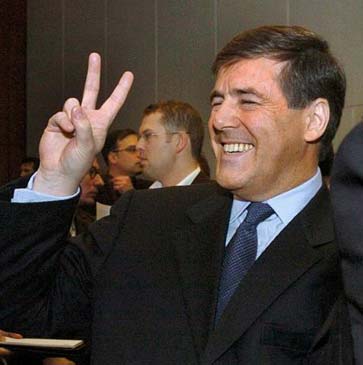

Good night!
Saturday, November 07, 2009
Kirk Stephenson
The risk of securities lending (or watch your counterparty)...
Kirk Stephenson (1961 - 2008)
Bloomberg, 2009-09-15: London suicide connects Lehman lesson missed by Hong Kong woman
Kirk Stephenson (1961 - 2008)
This memorial website was created in the memory of our loved one, Kirk Stephenson, who died on Thursday, September 25, 2008.20 Minuten, 2008-09-29: Millionär wirft sich vor Schnellzug
...
New Zealand born, he arrived in London in 1983 when he was in his early 20's as an SG Warburg graduate trainee and he never left. After his stint in he City, he went on to work as CFO and COO at several well-respected, large organisations including Amersham Plc, Coats Plc and the international iaw firm, Freshfields. Latterly he had worked as a director for the private equity firm Olivant set up in 2006, which came to prominence earlier this year as one of the potential bidders for Northern Rock.
Zusammen mit Luqman Arnold, der für kurze Zeit Konzernchef der UBS war, gründete Stephenson vor zwei Jahren die Beteiligungsgesellschaft Olivant Advisers. Diese übernahm im Juni dieses Jahres für über eine Milliarde Euro 2,5 Prozent der UBS-Aktien – ein folgenschwerer Fehler, wie sich mit dem Kurszerfall der UBS-Aktien herausstellte. 250 Millionen Euro soll Stephenson verloren haben.Olivant: Statement 1 October 2008
Olivant Limited has previously indicated that it is interested in shares in UBS representing 2.78% of the company. These shares were held through Lehman Brothers International (Europe) (“LBIE”). In light of the appointment of administrators to LBIE, Olivant Limited is evaluating the position of its interest in UBS and is in contact with the administrators to secure these assets.Olivant: Kirk Stephenson 2 October 2008
Our thoughts and condolences are with his wife and family.London Evening Standard, 2008-10-02: Mystery of ‘lost’ shares Olivant left at Lehman
City Spy hears it was “in the small print” that they could be moved on, that Lehman could use them to raise cash. Arnold said: “We are fortunate that we are a private company, and a company which has substantial paid-up capital, which means that this is not a drama for us.”FinishingWell, 2008-12-01: When the Pressure Became Too Great...
Oh no? The shares have vanished and you can't vote? Sounds pretty dramatic. Did Stephenson know Lehman could take them? If not, why not? How did Arnold find out and how did he react? Questions, questions. Unfortunately, the COO cannot answer them.
As Olivant's chief operating officer, Stephenson had approved the Lehman contract, and had left the firm and was negotiating a separation agreement. Several friends offered that Stephenson had recently told them that he was under enormous pressure at work. Still, his death was a tremendous shock to a wide circle of friends, not only in business, but also art and politics. Only a few weeks before Lehman's bankruptcy, Stephenson and his wife had gone to Verona, Italy, to see the opera with a friend who heads a London hedge fund. On Sunday, September 21st, Stephenson had attended his regular weekly tennis game. His playing partner said he didn't talk about specific problems, but made it clear that "things weren't easy" at work. His game was off and his spirits subdued. "He seemed down, pale, and had other things on his mind," Mr. Maher said.One year later and no news of the UBS shares... only some merger announcements of some Russian banks at the Olivant press release page. Hmm, those, Northern Rock, UBS, Lehman Brothers...
Clearly, the pressure had become too great. Stephenson was known to be fastidious about everything, from his neat handwriting to his ironed handkerchiefs. Mr. Maher, his tennis partner recalled him organizing the bills in his wallet so they faced the same way and were ordered in size. "Control was a very important feature for him," Mr. Maher offered. And clearly, the economic meltdown, and his financial demise, were too much for him to handle
Bloomberg, 2009-09-15: London suicide connects Lehman lesson missed by Hong Kong woman
The stocks and bonds of Lehman’s London brokerage customers, used as collateral to borrow more money, were frozen on September 15. About 3,500 clients, including 700 hedge funds, couldn’t get access to an estimated $65 billion of assets. PricewaterhouseCoopers, Lehman’s UK bankruptcy administrator, is still sorting out who should get paid and how much. Some firms have closed, and others may have to wait as long as a decade to get their assets back, Tony Lomas, the PwC partner in charge of the UK administration, said in August.His legacy
It took only 10 days for the ice-nine to get to Kirk Stephenson, chief operating officer of Olivant Ltd., a London private-equity firm run by former UBS AG Chairman Luqman Arnold. On September 25, Stephenson, 47, jumped in front of a train going 125 mph at a station in Taplow, 45 kilometers west of London.
The coroner’s office for the county of Buckinghamshire ruled the death a suicide. Stephenson, a native of New Zealand, was despondent about the financial crisis and talked about killing himself one week after Lehman’s demise, according to a statement from his wife read at the coroner’s inquest.
Lehman Brothers International (Europe) was Olivant’s prime broker. It held the firm’s 2.78-percent stake in UBS, Switzerland’s largest bank by assets, according to a statement from Olivant on October 1. The shares were worth 1.6 billion francs ($1.44 billion) at the time.
The hedge fund lock-up led the UK to reconsider its procedures when firms fail. While Lehman’s broker-dealer in the US stayed out of bankruptcy long enough to process many of its trades, the business seized up in the UK.
“In the US, everything was wrapped in cotton wool for four days,” said PwC’s Lomas. In the UK, “everything failed come 7:56 a.m. that Monday morning.”
The UK had an advantage in attracting hedge fund assets before the Lehman bankruptcy. While US prime brokers face limits on how much they can loan hedge funds, those rules could be circumvented with overseas units like Lehman’s in London. Some US clients didn’t know they were customers of Lehman Brothers International (Europe).
“If you didn’t pay attention to what you were signing, you would have missed it,” said Michael Romanek, principal at Rise Partners Ltd., which arranges financing for funds from London. “It was called enhanced prime brokerage, where they could be more accommodating with more leverage or loans. It just took signing some extra papers in New York. Most people didn’t realize it.”
No material is available.
Sunday, October 25, 2009
The Run On Goldman Sachs
Wall Street’s Near-Death Experience
By Andrew Ross Sorkin
November 2009
By Andrew Ross Sorkin
November 2009
Nevertheless, Stanley Druckenmiller, a George Soros acolyte worth more than $3.5 billion, had taken most of his money out earlier that week, concerned about the firm’s solvency. If word got around that a hedge-fund manager of Druckenmiller’s reputation had lost confidence in Goldman, that alone could cause a run. Cohn called him and tried to persuade him to return the money to the firm. “I have a long memory,” Cohn, who was taking this personally, told Druckenmiller, in whose honor he had even once hosted a charity cocktail party. “Look, the one thing I’m doing is I’m learning who my friends are and who my enemies are, and I’m making lists.”
Druckenmiller, however, was unmoved. “I don’t really give a shit—it’s my money!” he shot back. Unlike most hedge funds, Druckenmiller’s consisted primarily of his own money. “It’s my livelihood,” he said. “I’ve got to protect myself, and I don’t really give a shit what you have to say.”
“You can do whatever you want,” Cohn said in carefully measured tones. But, he added, “this will change our relationship for a long time.”
Subscribe to:
Posts (Atom)