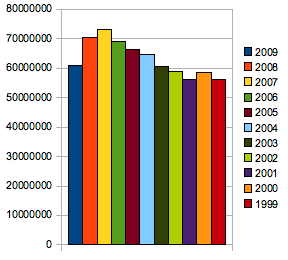
On 20 April 2010, the semi-submersible drilling rig Deepwater Horizon owned and operated by Transocean Limited caught fire in the US Gulf of Mexico and subsequently sank. The rig was drilling an exploration well on a BP deepwater lease. BP is committed to doing everything in its power to contain the environmental consequences of the incident.Not even the death of the 11 people is mentioned.
What is also very interesting from the 2009 annual report:
Total exploration expense in 2009 of $1,116 million (2008 $882 million and 2007 $756 million) included the write-off of expenses related to unsuccessful drilling activities in the deepwater Gulf of Mexico ($391 million), India ($31 million), Angola ($28 million), Egypt ($27 million), and others ($31 million).Put this in relation to this quote from a Deepwater Horizon witness:
[Mike Williams, the chief electronics technician on the Deepwater Horizon, and one of the last workers to leave the doomed rig] said they were told it would take 21 days; according to him, it actually took six weeks.Now, how much is actually produced by BP down there in different fields in the Gulf every day?
With the schedule slipping, Williams says a BP manager ordered a faster pace.
"And he requested to the driller, 'Hey, let's bump it up. Let's bump it up.' And what he was talking about there is he's bumping up the rate of penetration. How fast the drill bit is going down," Williams said.
Williams says going faster caused the bottom of the well to split open, swallowing tools and that drilling fluid called "mud."
"We actually got stuck. And we got stuck so bad we had to send tools down into the drill pipe and sever the pipe," Williams explained.
That well was abandoned and Deepwater Horizon had to drill a new route to the oil. It cost BP more than two weeks and millions of dollars.
"We were informed of this during one of the safety meetings, that somewhere in the neighborhood of $25 million was lost in bottom hole assembly and 'mud.' And you always kind of knew that in the back of your mind when they start throwing these big numbers around that there was gonna be a push coming, you know? A push to pick up production and pick up the pace," Williams said.
Asked if there was pressure on the crew after this happened, Williams told Pelley, "There's always pressure, but yes, the pressure was increased."
Field 2009So make your own guess, how much is coming out there free flowing every day!
Thunder Horse 133'000 bpd
Atlantis 54'000 bpd
Mad Dog 35'000 bpd
Mars 29'000 bpd
Na Kika 27'000 bpd
Horn Mountain 25'000 bpd
King 22'000 bpd
Other 62'000 bpd
Total 387'000 bpd
Here is what Mad Hedge is worried about:
All of BP’s efforts to date have really been “Hail Mary’s” doomed to failure. The only real chance is to relieve the pressure by drilling several adjacent wells, and that will take months. If BP has discovered the mother of all fields with pressures so enormous, they can’t be controlled with modern technology, a possibility which some geologists admit, then more huge leaks will spring and the nuclear option will be the only one left. In the meantime, if a serious hurricane hits the region, a mathematical probability, then we will see the environmental equivalent of Chernobyl meets Katrina. In this scenario, you can kiss BP goodbye.So how big could the field be, how much oil is down there that could potentially come up?
From Bloomberg: Anadarko Says BP Should Pay After Being Reckless
1 Billion Barrels?For comparison, Exxon Valdez spilled 0.27 million barrels into the sea. Around a million is estimated to have come already out of the current leak. BTW, BP has total net proved crude oil reserves (not considering natural gas reserves) of 10.5 billion barrels.
The ruptured well may hold as much as 1 billion barrels, the Times reported, citing Rick Mueller, an analyst at Energy Security Analysis in Massachusetts. BP previously estimated the field contained 50 million to 100 million barrels of oil, the U.K. newspaper said.
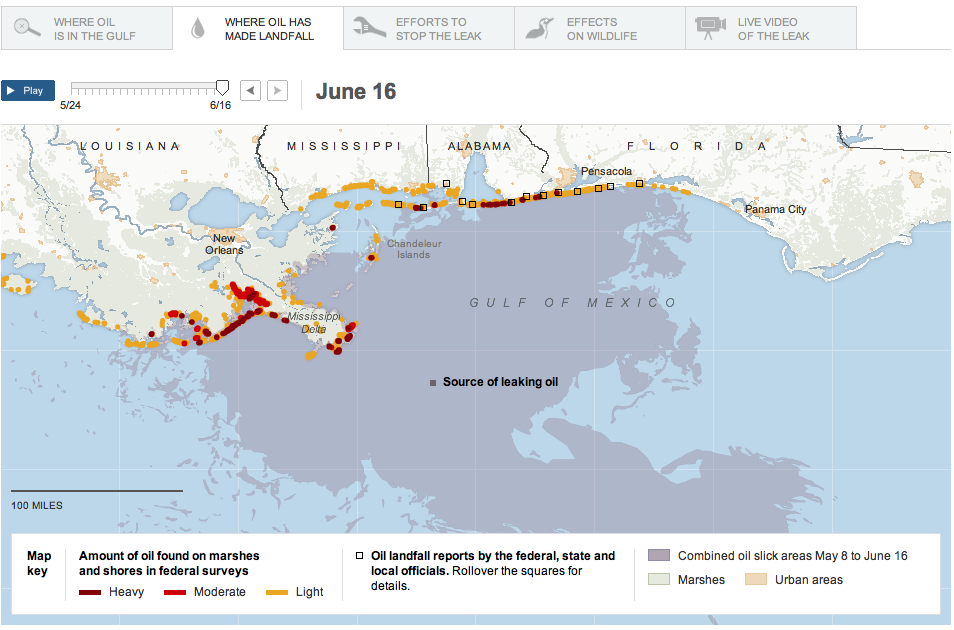
Not that there isn't already enough oil out there in the sea (NYTimes graphic via The Big Picture):
Last not least, zero hedge has lots of interesting topographical sea maps of the area around spill: