Compounding Interest, present value, future value, etc.
Updated 2011-04-11, here is another financial calculator, that includes all different variables in a single form.
Thursday, March 17, 2011
Sunday, November 28, 2010
Silver
Unlike gold, silver production is consumed to a very high degree!
From Wikipedia:
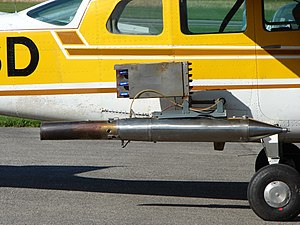
(a silver iodide generator for cloud seeding)

From Wikipedia:
(a silver iodide generator for cloud seeding)
Silver ... has the highest electrical conductivity of any element and the highest thermal conductivity of any metal.Furthermore from the Amalgam Wikipedia page, "Silver-mercury amalgams are important in dentistry".
...
Today, silver metal is also used in electrical contacts and conductors, in mirrors and in catalysis of chemical reactions. Its compounds are used in photographic film and dilute silver nitrate solutions and other silver compounds are used as disinfectants and microbiocides. While many medical antimicrobial uses of silver have been supplanted by antibiotics, further research into clinical potential continues.
...
Currency
...
The name of the United Kingdom monetary unit "pound" (£) reflects the fact that it originally represented the value of one troy pound of sterling silver. In the 1800s, many nations, such as the United States and Great Britain, switched from silver to a gold standard of monetary value, then in the 20th century to fiat currency.
...
Photography and electronics
Photography used 30.98% of the silver consumed in 1998 in the form of silver nitrate and silver halides. In 2001, 23.47% was used for photography, while 20.03% was used in jewelry, 38.51% for industrial uses, and only 3.5% for coins and medals. The use of silver in photography has rapidly declined, due to the lower demand for consumer color film from the advent of digital technology, since in 2007 of the 894.5 million ounces of silver in supply, just 128.3 million ounces (14.3%) were consumed by the photographic sector, and the total amount of silver consumed in 2007 by the photographic sector compared to 1998 is just 50%.
Some electrical and electronic products use silver for its superior conductivity, even when tarnished. For example, printed circuits can be made using silver paints,[6] and computer keyboards use silver electrical contacts. Some high-end audio hardware (DACs, preamplifiers, etc.) are fully silver-wired, which is believed to cause the least loss of quality in the signal. Silver cadmium oxide is used in high voltage contacts because it can withstand arcing.
Mirrors and optics
Mirrors which need superior reflectivity for visible light are made with silver as the reflecting material in a process called silvering, though common mirrors are backed with aluminium. Using a process called sputtering, silver (and sometimes gold) can be applied to glass at various thicknesses, allowing different amounts of light to penetrate. Silver is usually reserved for coatings of specialized optics, and the silvering most often seen in architectural glass and tinted windows on vehicles is produced by sputtered aluminium, which is cheaper and less susceptible to tarnishing and corrosion. Silver is the reflective coating of choice for solar reflectors.
...
Small devices such as hearing aids and watches commonly use Silver oxide batteries due to their long life and high energy/weight ratio. Another usage is high-capacity silver-zinc and silver-cadmium batteries.
Saturday, November 27, 2010


Monday, August 16, 2010

Friday, August 13, 2010
Germany's Gold
The German Gold treasury is actually hosted in New York, London, and Paris. Ein Schelm, wer Böses dabei denkt.
manager magazin (in German): 3440 Tonnen mythische Fracht
manager magazin (in German): 3440 Tonnen mythische Fracht
Nach Angaben des "World Gold Council" betragen die offiziellen Goldreserven Deutschlands derzeit 3439,5 Tonnen. Dies entspricht 45,6 Prozent der Gesamtreserven oder einem Wert von rund 36,5 Milliarden Euro. Das Edelmetall ist in Barren à 12,5 Kilo gegossen und wird überwiegend in einem Tresor in Manhattan gelagert. Dort betreibt die US-Notenbank für 60 Nationen das mit 550.000 Barren größte Goldlager der Welt.Prof. Hans-Helmut Kotz was a member of the executive board of the Bundesbank from 2002 till 2010. The stern interview was in 2004.
"Der größte Teil unserer Goldreserven wird außerhalb deutscher Grenzen, wo er entstanden ist, gehalten: bei der Fed in New York, bei der Bank of England in London und der Banque de France in Paris. In dieser Reihenfolge", sagte Kotz dem Stern.
In den 50er und 60er Jahren waren der Bundesbank dort aufgrund außenwirtschaftlicher Überschüsse Deutschlands die Goldreserven von anderen Nationen übertragen worden. Wegen der hohen Kosten für Transport und Bau neuer Tresore lehnt es die Bundesbank aus betriebswirtschaftlichen Gründen ab, die Goldbarren nach Deutschland zu schaffen.
Thursday, August 05, 2010
Kleingeld
Pocket change currently in use:
Source: SIX Telekurs
| No | Fractional Currency | Countries |
| 1. | Cent | 28 |
| 2. | Centavo | 16 |
| 3. | Cents | 10 |
| 4. | Centime | 9 |
| 5. | Fils | 6 |
| 6. | Centimes | 4 |
| 7. | Sen | 4 |
| 8. | Centesimo | 3 |
| 9. | Centimos | 3 |
| 10. | Bani | 2 |
| 11. | Centavos | 2 |
| 12. | Centimo | 2 |
| 13. | Chon | 2 |
| 14. | Dirham | 2 |
| 15. | New Pence / Pence | 2 |
| 16. | Ore | 2 |
| 17. | Paisa | 2 |
| 18. | Piastres | 2 |
| 19. | Agorot | 1 |
| 20. | Att | 1 |
| 21. | Aurar (inactive) | 1 |
| 22. | Avos | 1 |
| 23. | Baizas | 1 |
| 24. | Bututs | 1 |
| 25. | Cantimo | 1 |
| 26. | Centas | 1 |
| 27. | Centesimos | 1 |
| 28. | Chetrum | 1 |
| 29. | Deni | 1 |
| 30. | Dinar | 1 |
| 31. | Diram | 1 |
| 32. | Fen | 1 |
| 33. | Fening | 1 |
| 34. | Filler | 1 |
| 35. | Ghana Pesewas | 1 |
| 36. | Groszy | 1 |
| 37. | Haleru | 1 |
| 38. | Hallalas | 1 |
| 39. | Hellers | 1 |
| 40. | Iraimbilanja | 1 |
| 41. | Khoums | 1 |
| 42. | Kobo | 1 |
| 43. | Kopek | 1 |
| 44. | Kopeken | 1 |
| 45. | Kurus | 1 |
| 46. | Laari | 1 |
| 47. | Lipa | 1 |
| 48. | Lisente | 1 |
| 49. | Lumma | 1 |
| 50. | Millimes | 1 |
| 51. | Mongo | 1 |
| 52. | New Pence | 1 |
| 53. | Ngwee | 1 |
| 54. | Oere | 1 |
| 55. | Paise | 1 |
| 56. | Para | 1 |
| 57. | Pence | 1 |
| 58. | Piaster | 1 |
| 59. | Piastre | 1 |
| 60. | Poisha | 1 |
| 61. | Pyas | 1 |
| 62. | Qapik | 1 |
| 63. | Qindarka | 1 |
| 64. | Rappen | 1 |
| 65. | Santims | 1 |
| 66. | Satang | 1 |
| 67. | Sene | 1 |
| 68. | Seniti | 1 |
| 69. | Senti | 1 |
| 70. | Stotinki | 1 |
| 71. | Tambala | 1 |
| 72. | Tenge | 1 |
| 73. | Tetri | 1 |
| 74. | Thebe | 1 |
| 75. | Tiin | 1 |
| 76. | Tijin | 1 |
| 77. | Toea | 1 |
| 78. | Tyin | 1 |
| 79. | XU | 1 |
Source: SIX Telekurs
Wednesday, August 04, 2010
AuM
Assets under Management (in German)
UBS bleibt zweitgrösster Vermögensverwalter
UBS bleibt zweitgrösster Vermögensverwalter
1 Bank of America: 1,740.51 Milliarden Dollar
2 UBS: 1,593.74 Milliarden Dollar
3 Morgan Stanley: 1,508.00 Milliarden Dollar
4 Wells Fargo: 1,218.00 Milliarden Dollar
5 Credit Suisse: 775.43 Milliarden Dollar
6 JP Morgan: 636.00 Milliarden Dollar
7 Royal Bank of Canada: 379.00 Milliarden Dollar
8 HSBC: 367.00 Milliarden Dollar
9 Deutsche Bank: 272.38 Milliarden Dollar
10 Pictet: 243.21 Milliarden Dollar
Quelle: Scorpio Partnership 2010 Global Private Banking
Monday, August 02, 2010
ISO Codes
Country and currency ISO codes:
English country names and code elements
HTML
TXT
ISO 4217 currency and funds name and code elements
English country names and code elements
HTML
TXT
ISO 4217 currency and funds name and code elements
Thursday, July 22, 2010
A Forced Investment
See this video of Brady Dougan (in English), Credit Suisse CEO, best earning banker in the world (71 USD million bonus?!):
The record bonus was "a forced investment", people have to see the context.
He is sweating ... at least.
Yes, really, I am curious, why are you leading C. Suisse, and where?
Where did Ospel lead the U. B. of Switzerland? At least we know why:).
The record bonus was "a forced investment", people have to see the context.
He is sweating ... at least.
Yes, really, I am curious, why are you leading C. Suisse, and where?
Where did Ospel lead the U. B. of Switzerland? At least we know why:).
Monday, June 28, 2010
BP Gossip
From the Mad Hedge Fund Trader: The Value Play on BP
Some of the chatter that came back was amazing. BP has discovered the largest and most powerful well in history, and control of it may be outside existing technology. The previous record gusher was Union Oil Co.’s Lakeview well in Maricopa, California, which spewed out a staggering 100,000 barrels a day at its peak in 1910, and created an enormous oil lake in the central part of the state. My grandfather worked there for Standard Oil during the Great Depression, and 2o years later, oil was still everywhere.
Estimates for the BP well now range up to 50% more than that. The pressures at 18,000 feet are so enormous, that drilling two more relief wells might only result in creating two more oil spills. If Obama doesn’t want to take the nuclear option, (click here for my piece at http://www.madhedgefundtrader.com/june_4__2010.html ), then there will be no other alternative but for the spill to continue until the field exhausts itself or becomes capable, possibly some time next year.
This is not the end of the world. Less than 1% of the spilled oil is ending up on the beaches. Watch TV, and that is not 150,000 barrels on the beach in Pensacola, Florida. Most of the crude is being moved parallel to the coast by the current and will eventually end up in the mid-Atlantic, where it will break down or dissipate. Tropical sunlight, salt water, and crude are all highly corrosive, and the three don’t last together long.
Using the high end estimates, and assuming that it takes a year to run out, possibly 36 million barrels will end up in the sea (pressure is declining). This is the same amount of oil that was dumped into the Atlantic during WWII, when 452 tankers were sunk by German U-boats, mostly along the US east coast, and when tar balls on the beach were a daily occurrence. This is on top of the 1.5 million barrels a year that leak into the Gulf through natural seepage, which no one ever notices.
One way or the other, this will end, and Western civilization will survive. And by the way, the crude price rise brought by the spill also marked up the value of BP’s reserves, easily allowing it to cover the cost of the clean up, no matter how big it is. This is how profitable this company is, and why they were so generous with a $20 billion contingency fund.
No sooner did I put out the call the buy the pariah stock at $29, than I hear Whitney Tilson of T2 Partners, one of the giants of the value corner in the hedge fund universe, is doing the same. Whitney has come up with a few more arguments which I haven’t thought of, which I will happily pass on.
For a start, no company has ever made more mistakes than BP, and panic is rife. Great time to buy. BP has the fourth largest revenue of any company in the world after, guess what, three other energy companies, Gazprom (GZPFY.PK), Exxon Mobile (XOM), and Royal Dutch Shell (RDS/A). Pre crisis Q1 operating profit estimates were at a staggering $34 billion, and the net at $22 billion.
While the environmental damage is substantial, it is nowhere near as bad as when 11 million barrels of crude poured into the Persian Gulf during Desert Storm in 1991, which is one sixth the size of the Gulf of Mexico.
Sunday, June 20, 2010
BP Reporting
This is all that is mentioned in the BP first quarter of 2010 report:
What is also very interesting from the 2009 annual report:
Here is what Mad Hedge is worried about:
From Bloomberg: Anadarko Says BP Should Pay After Being Reckless
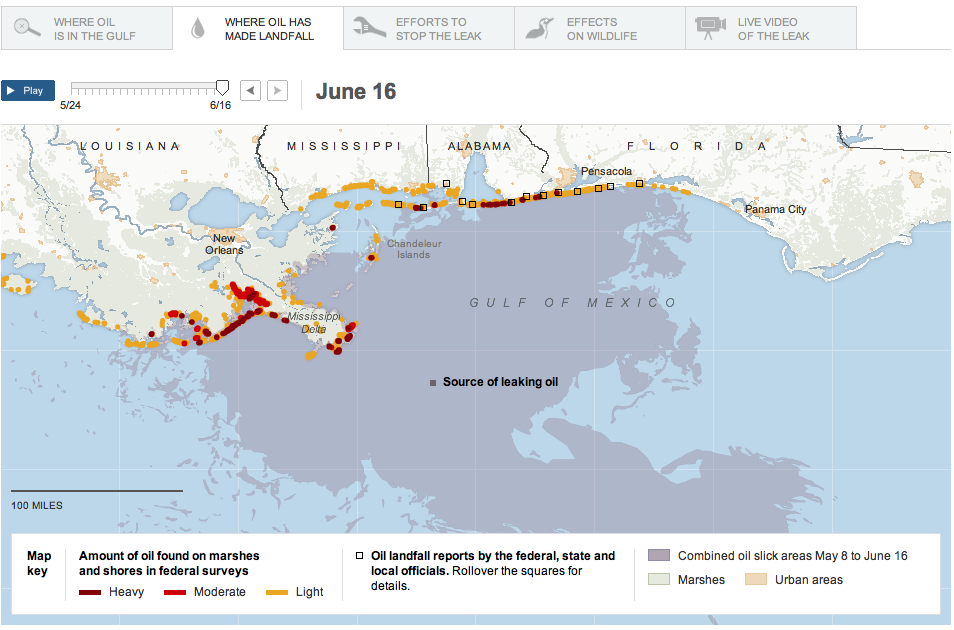
Not that there isn't already enough oil out there in the sea (NYTimes graphic via The Big Picture):
Last not least, zero hedge has lots of interesting topographical sea maps of the area around spill:

On 20 April 2010, the semi-submersible drilling rig Deepwater Horizon owned and operated by Transocean Limited caught fire in the US Gulf of Mexico and subsequently sank. The rig was drilling an exploration well on a BP deepwater lease. BP is committed to doing everything in its power to contain the environmental consequences of the incident.Not even the death of the 11 people is mentioned.
What is also very interesting from the 2009 annual report:
Total exploration expense in 2009 of $1,116 million (2008 $882 million and 2007 $756 million) included the write-off of expenses related to unsuccessful drilling activities in the deepwater Gulf of Mexico ($391 million), India ($31 million), Angola ($28 million), Egypt ($27 million), and others ($31 million).Put this in relation to this quote from a Deepwater Horizon witness:
[Mike Williams, the chief electronics technician on the Deepwater Horizon, and one of the last workers to leave the doomed rig] said they were told it would take 21 days; according to him, it actually took six weeks.Now, how much is actually produced by BP down there in different fields in the Gulf every day?
With the schedule slipping, Williams says a BP manager ordered a faster pace.
"And he requested to the driller, 'Hey, let's bump it up. Let's bump it up.' And what he was talking about there is he's bumping up the rate of penetration. How fast the drill bit is going down," Williams said.
Williams says going faster caused the bottom of the well to split open, swallowing tools and that drilling fluid called "mud."
"We actually got stuck. And we got stuck so bad we had to send tools down into the drill pipe and sever the pipe," Williams explained.
That well was abandoned and Deepwater Horizon had to drill a new route to the oil. It cost BP more than two weeks and millions of dollars.
"We were informed of this during one of the safety meetings, that somewhere in the neighborhood of $25 million was lost in bottom hole assembly and 'mud.' And you always kind of knew that in the back of your mind when they start throwing these big numbers around that there was gonna be a push coming, you know? A push to pick up production and pick up the pace," Williams said.
Asked if there was pressure on the crew after this happened, Williams told Pelley, "There's always pressure, but yes, the pressure was increased."
Field 2009So make your own guess, how much is coming out there free flowing every day!
Thunder Horse 133'000 bpd
Atlantis 54'000 bpd
Mad Dog 35'000 bpd
Mars 29'000 bpd
Na Kika 27'000 bpd
Horn Mountain 25'000 bpd
King 22'000 bpd
Other 62'000 bpd
Total 387'000 bpd
Here is what Mad Hedge is worried about:
All of BP’s efforts to date have really been “Hail Mary’s” doomed to failure. The only real chance is to relieve the pressure by drilling several adjacent wells, and that will take months. If BP has discovered the mother of all fields with pressures so enormous, they can’t be controlled with modern technology, a possibility which some geologists admit, then more huge leaks will spring and the nuclear option will be the only one left. In the meantime, if a serious hurricane hits the region, a mathematical probability, then we will see the environmental equivalent of Chernobyl meets Katrina. In this scenario, you can kiss BP goodbye.So how big could the field be, how much oil is down there that could potentially come up?
From Bloomberg: Anadarko Says BP Should Pay After Being Reckless
1 Billion Barrels?For comparison, Exxon Valdez spilled 0.27 million barrels into the sea. Around a million is estimated to have come already out of the current leak. BTW, BP has total net proved crude oil reserves (not considering natural gas reserves) of 10.5 billion barrels.
The ruptured well may hold as much as 1 billion barrels, the Times reported, citing Rick Mueller, an analyst at Energy Security Analysis in Massachusetts. BP previously estimated the field contained 50 million to 100 million barrels of oil, the U.K. newspaper said.
Not that there isn't already enough oil out there in the sea (NYTimes graphic via The Big Picture):
Last not least, zero hedge has lots of interesting topographical sea maps of the area around spill:
Saturday, June 12, 2010
Palladium Production
| Source: "Platinum 2010" by David Jollie (from Johnson Matthey) | ||||||
| Supply | ||||||
| 1'000 oz | 2005 | 2006 | 2007 | 2008 | 2009 | |
| South Africa | 2'605 | 2'775 | 2'765 | 2'430 | 2'370 | |
| Russia | ||||||
| Primary | 3'135 | 3'220 | 3'050 | 2'700 | 2'675 | |
| Stock Sales | 1'485 | 700 | 1'490 | 960 | 960 | |
| North America | 910 | 985 | 990 | 910 | 755 | |
| Zimbabwe | 125 | 135 | 135 | 140 | 180 | |
| Others | 145 | 135 | 150 | 170 | 160 | |
| Total Supply | 8'405 | 7'950 | 8'580 | 7'310 | 7'100 | |
| Total Production | 6'920 | 7'250 | 7'090 | 6'350 | 6'140 | |
| Gross Demand | ||||||
| Autocatalyst | 3'865 | 4'015 | 4'545 | 4'465 | 4'050 | |
| Chemical | 415 | 440 | 375 | 350 | 325 | |
| Dental | 815 | 620 | 630 | 625 | 615 | |
| Electrical | 1'275 | 1'495 | 1'550 | 1'370 | 1'270 | |
| Investment | 220 | 50 | 260 | 420 | 625 | |
| Jewellery | 1'490 | 1'140 | 950 | 985 | 815 | |
| Other | 265 | 85 | 85 | 75 | 70 | |
| Total Gross Demand | 8'345 | 7'845 | 8'395 | 8'290 | 7'770 | |
| Recycling | ||||||
| Autocatalyst | -625 | -805 | -1'015 | -1'140 | -965 | |
| Electrical | -305 | -290 | -315 | -345 | -395 | |
| Jewellery | -60 | -135 | -235 | -130 | -70 | |
| Total Recycling | -990 | -1'230 | -1'565 | -1'615 | -1'430 | |
| Total Net Demand | 7'355 | 6'615 | 6'830 | 6'675 | 6'340 | |
| Movements in Stocks | -435 | 635 | 260 | -325 | -200 | |
| 1 t = 32'150.75 oz | ||||||
| t | 2005 | 2006 | 2007 | 2008 | 2009 | |
| South Africa | 81.02 | 86.31 | 86.00 | 75.58 | 73.72 | |
| Russia | ||||||
| Primary | 97.51 | 100.15 | 94.87 | 83.98 | 83.20 | |
| Stock Sales | 46.19 | 21.77 | 46.34 | 29.86 | 29.86 | |
| North America | 28.30 | 30.64 | 30.79 | 28.30 | 23.48 | |
| Zimbabwe | 3.89 | 4.20 | 4.20 | 4.35 | 5.60 | |
| Others | 4.51 | 4.20 | 4.67 | 5.29 | 4.98 | |
| Total Supply | 261.42 | 247.27 | 266.87 | 227.37 | 220.83 | |
| Total Production | 215.24 | 225.50 | 220.52 | 197.51 | 190.98 | |
| Gross Demand | ||||||
| Autocatalyst | 120.21 | 124.88 | 141.37 | 138.88 | 125.97 | |
| Chemical | 12.91 | 13.69 | 11.66 | 10.89 | 10.11 | |
| Dental | 25.35 | 19.28 | 19.60 | 19.44 | 19.13 | |
| Electrical | 39.66 | 46.50 | 48.21 | 42.61 | 39.50 | |
| Investment | 6.84 | 1.56 | 8.09 | 13.06 | 19.44 | |
| Jewellery | 46.34 | 35.46 | 29.55 | 30.64 | 25.35 | |
| Other | 8.24 | 2.64 | 2.64 | 2.33 | 2.18 | |
| Total Gross Demand | 259.56 | 244.01 | 261.11 | 257.85 | 241.67 | |
| Recycling | ||||||
| Autocatalyst | -19.44 | -25.04 | -31.57 | -35.46 | -30.01 | |
| Electrical | -9.49 | -9.02 | -9.80 | -10.73 | -12.29 | |
| Jewellery | -1.87 | -4.20 | -7.31 | -4.04 | -2.18 | |
| Total Recycling | -30.79 | -38.26 | -48.68 | -50.23 | -44.48 | |
| Total Net Demand | 228.77 | 205.75 | 212.44 | 207.62 | 197.20 | |
| Movements in Stocks | -13.53 | 19.75 | 8.09 | -10.11 | -6.22 | |
Tuesday, June 08, 2010
Subscribe to:
Posts (Atom)